Great Pyramid of Giza
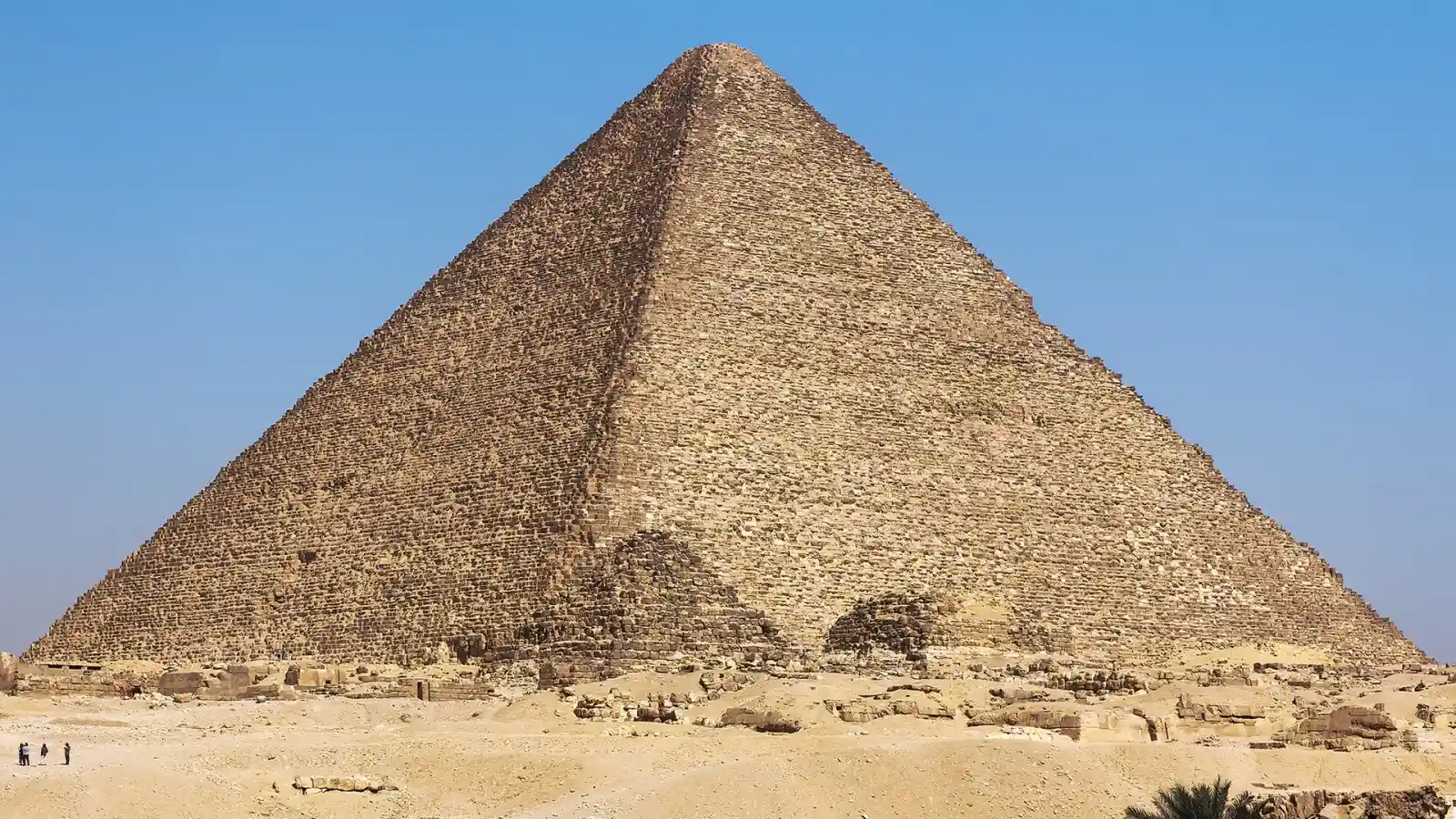
The last surviving wonder of the ancient world. It is generally understood to have been built as Pharaoh Khufu's tomb and stood as the world's tallest human-made structure for roughly 3,800 years.
The Great Pyramid of Giza is the only surviving wonder of the ancient world. It is generally understood to have been built as the tomb of King Khufu, a ruler of Egypt’s Fourth Dynasty. It originally rose to about 146.5 metres, and for roughly 3,800 years no human-made structure stood higher.
At Giza, the pyramid stands inside a funerary complex with temples, causeways, subsidiary pyramids, boat burials, a river port, and a large cemetery for the people who served the royal court. The stone mountain draws the eye, but it was only the most obvious part of the project.
The pyramid and the cemetery around it
The pyramid stands on the Giza Plateau, part of the wider necropolis of Memphis. UNESCO’s property follows the royal cemeteries and monuments from Giza through Abusir, Saqqara, and Dahshur. Together they show Egyptian funerary architecture developing over centuries, from mastabas to the great pyramids.
Khufu’s complex included the pyramid, a mortuary temple on the eastern side, a long causeway, and a valley temple nearer the ancient edge of the floodplain. Smaller pyramids belonged to members of the royal family. Mastaba tombs around the complex housed officials and relatives whose place in the afterlife was connected to the king’s.
The complex needed priests, offering supplies, craftsmen, administrators, and transport. A royal tomb on this scale was also a permanent institution. The tombs around it show how the people who worked for the court placed themselves within that system, even after death.
Building Khufu’s tomb
Most of the pyramid is built from limestone quarried on the Giza Plateau. Its original outer skin was made from fine limestone brought from Tura, south of modern Cairo, by boat. Much of that casing was removed in later centuries. The rough stepped core visible today is not the finished exterior Khufu’s builders intended. The completed pyramid would have presented a smooth, bright surface.
Inside are three principal chambers: one cut into the bedrock and two built high in the body of the pyramid. The upper room, usually called the King’s Chamber, still contains the stone sarcophagus made for Khufu. The route to it passes through the Grand Gallery, a steep, corbelled space whose scale is startling even after centuries of visitors.
Lifting the blocks was only one part of the job. They had to be quarried, shaped, moved, placed, and counted. Workers needed food, water, tools, fuel, shelter, and replacement materials. The pyramid is as much evidence of administration as of geometry. A single ramp, however ingenious, cannot account for a project that ran across the plateau for years and probably decades. The work depended on an organised labour force and on knowledge passed from one stage of construction to the next.
Two large boats were found dismantled in pits on the south side. They are generally understood as royal funerary equipment, perhaps intended for the king and his burial goods. Their presence ties the pyramid to the Nile and to the movement of people and objects that made the whole complex function.
What is inside the pyramid?
The passages were never meant to be a visitor route. The descending passage reaches the chamber below ground; the ascending route leads toward the Grand Gallery and the rooms high in the masonry. Changes in height and direction served the burial and the protection of the royal remains. They also turned the inside of the pyramid into a sequence of controlled spaces rather than a simple empty core.
Modern scanning has identified spaces and anomalies that cannot be reached easily from inside. Finding a void does not tell us what it was for. It could be structural, unfinished, or part of a passage whose purpose is still unclear. The scans have added evidence, not a final answer.
Giza is larger than Khufu’s pyramid
Seen on its own, the Great Pyramid loses its proper scale. The other pyramids, temples, cemeteries, workers’ areas, and the Great Sphinx belong to the same historical setting. UNESCO’s Memphis and its Necropolis property includes more than thirty-eight pyramids and thousands of rock-cut tombs. Together they record how the Egyptian capital organised labour, religion, land, transport, and memory.
Khufu’s pyramid has outlasted the political system that built it, the institutions that maintained its cult, and much of the city that supported it. Its casing is mostly gone, the summit has been reduced, and its chambers have been entered for centuries. Even in that altered state, the pyramid still shows the scale of the original undertaking and the reach of the state behind it.