
Avebury
Largest prehistoric stone circle in Europe, surrounding an entire village. Easier to overlook than Stonehenge, and bigger.
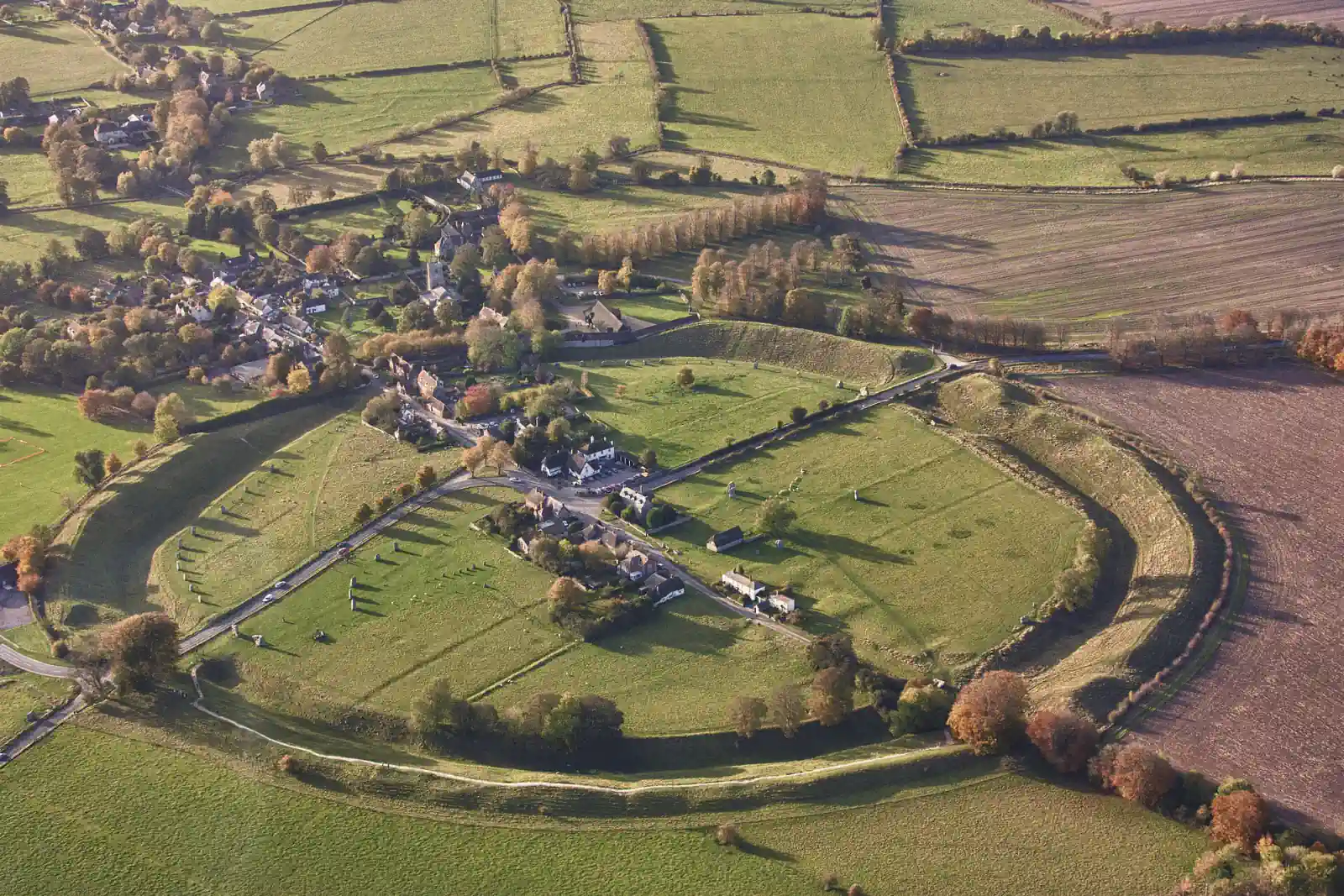
At Avebury, the road enters the monument before many visitors realise they have arrived. Houses, a pub, paths and fields occupy the same ground as an enormous Neolithic earthwork. The surviving stones do not stand apart from the present village. They rise beside gardens and lanes, while the bank and ditch curve around them on a scale that is difficult to grasp from ground level.
The familiar label “stone circle” is accurate but incomplete. Avebury is a henge containing one large outer circle and the remains of two smaller circles. It also belongs to a wider ceremonial landscape that includes avenues of paired stones, burial mounds, enclosures and Silbury Hill. These features were not designed in a single moment. Communities returned to this part of Wiltshire for many generations, changing the landscape as their own lives and rituals changed.
Building a monument over generations
Farming communities were active around Avebury by the fourth millennium BCE. Windmill Hill, to the northwest, preserves a causewayed enclosure where people gathered, deposited objects and engaged in activities that remain only partly understood. West Kennet Long Barrow, south of Avebury, held human remains in stone-built chambers. Both predate the great henge.
The bank and internal ditch at Avebury were constructed around 4,600 years ago. Digging the ditch through chalk with stone and antler tools demanded sustained labour. Material removed from it was piled outside to form the bank. The arrangement created a bounded interior, although archaeologists cannot reduce its use to one ceremony or one purpose.
The outer stone circle, roughly 330 metres across, is the largest known prehistoric stone circle. Within it stood two separate inner settings. Stones were brought from the surrounding chalk downs, where natural sarsen boulders lay on or near the surface. Some weigh many tonnes. Their irregular forms were retained, and the builders appear to have selected and positioned particular stones with care.
Construction continued in stages. The West Kennet and Beckhampton avenues linked the henge to other places in the landscape. At the far end of the West Kennet Avenue, the Sanctuary developed through successive rings of timber posts and stone. Movement between monuments may have been as significant as the monuments themselves.
Earlier lives beneath the circle
Archaeology has complicated the idea that Avebury began on empty ground. Work by the Living with Monuments project identified traces of a much earlier Neolithic occupation inside the southern inner circle. Geophysical survey and excavation indicate structures associated with a settlement, including a square arrangement that the later stone setting appears to have preserved or recalled.
The evidence does not prove that Avebury was built around the home of a specific revered individual. It does show that people knew this place long before the great stones were raised. Houses, memories and ancestral associations may have helped determine where later monuments went. The discovery brings domestic life into a landscape often described only in ceremonial terms.
That mixture appears across the World Heritage property. Long barrows contained the dead, enclosures hosted gatherings, and later monuments organised movement through the downs. Silbury Hill, built in several phases, became the largest prehistoric artificial mound in Europe, yet no burial has been found at its centre. The labour invested in these places tells us that communities could coordinate large projects. It does not tell us that every project served the same belief.
Stones lost, buried and raised again
Avebury changed long after the Neolithic period. During the Middle Ages, some stones were pulled down and buried. One fallen stone trapped and killed a man, probably in the fourteenth century; his remains and possessions were found when the stone was lifted in 1938. Later destruction was more systematic. From the seventeenth century onward, stones were broken up for building material and to clear land.
The antiquarian William Stukeley recorded Avebury in the 1720s and 1730s while this destruction was still taking place. His plans are imperfect, but they preserve evidence for stones and arrangements that subsequently disappeared. In the 1930s, archaeologist Alexander Keiller excavated parts of the monument and re-erected several stones. He marked some missing positions with concrete pillars.
What visitors see today is therefore ancient fabric shaped by later removal, documentation and restoration. A standing stone may have remained upright since prehistory, or it may have been reset in the twentieth century. Recognising that history does not diminish Avebury. It makes the visible monument easier to read honestly.
A living place inside a prehistoric boundary
Avebury is unusual because daily life continues within the henge. The village, roads and farms introduce pressure from traffic, erosion and development, but they also prevent the monument from becoming a sealed archaeological display. People live among the stones, and visitors can walk through much of the site without a fixed route.
The henge also holds meaning for modern Pagan and Druid communities, particularly at seasonal gatherings. Their practices are contemporary, even when they draw inspiration from imagined or reconstructed prehistory. They form part of Avebury's current social life and must share the site with residents, researchers, farmers and other visitors.
No surviving text explains why Neolithic communities built Avebury. Archaeology can reconstruct sequences, materials, labour and changing patterns of use, but the intentions behind individual stones remain open. The monument's strongest lesson is less romantic and more human: a landscape could gather memory for centuries, and each generation could add something without erasing everything that came before.