
Bamiyan
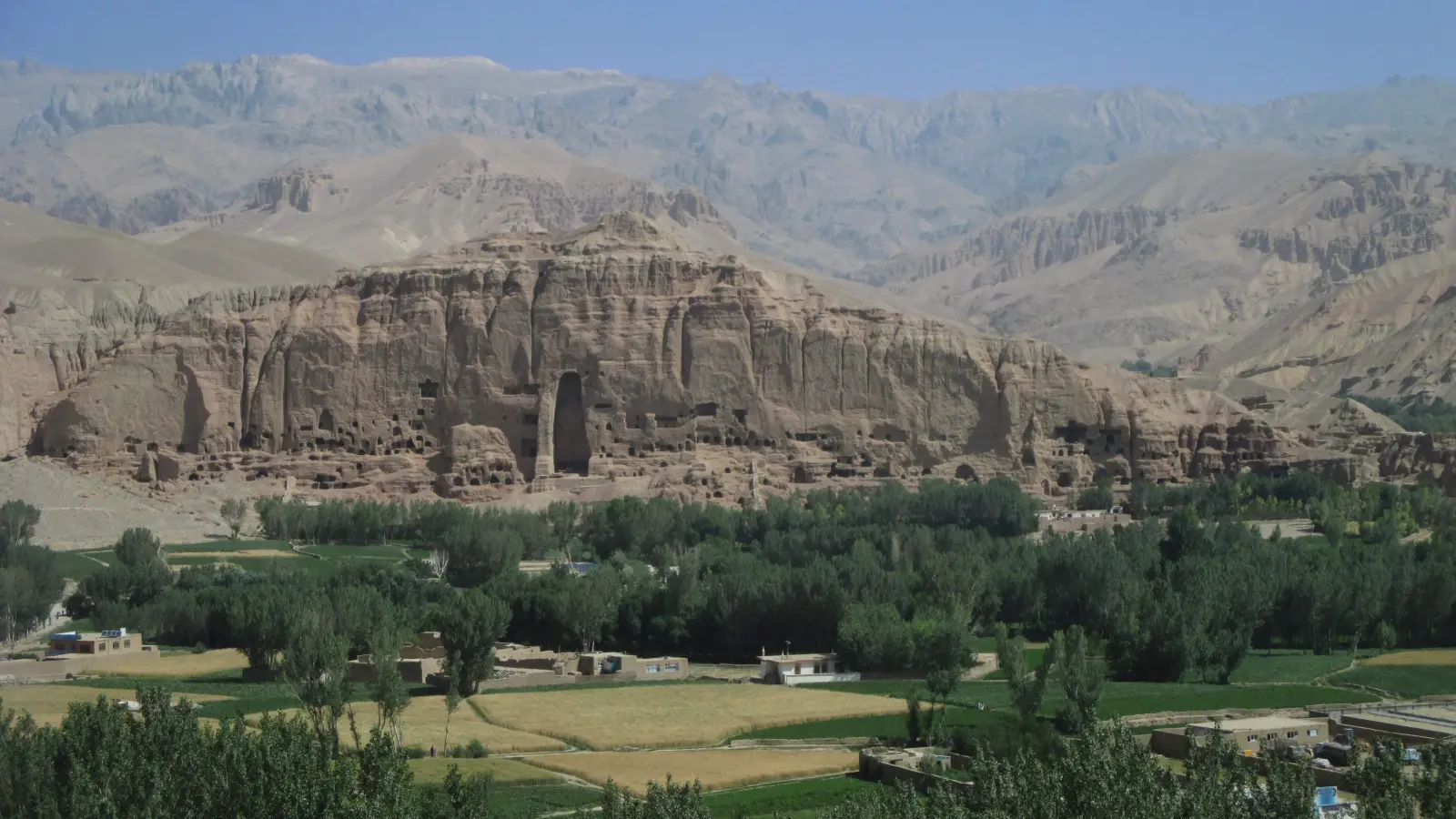
Two colossal standing Buddhas carved into a sandstone cliff, dynamited by the Taliban in 2001. The empty niches remain.
Two enormous recesses interrupt the sandstone cliff above Afghanistan's Bamiyan Valley. For centuries they held standing figures of the Buddha, one about 55 metres high and the other about 38 metres. The Taliban destroyed both statues with explosives in March 2001. Their absence is now the most recognisable feature of the site.
The empty niches can make Bamiyan seem like the remains of two monuments and a single act of destruction. The archaeological landscape is much larger. Hundreds of caves, painted sanctuaries, monastic spaces, fortified settlements and traces of later Islamic occupation stretch through the valley and its tributaries. Bamiyan was a place where people worshipped, travelled, traded, farmed and built for more than a millennium.
A Buddhist centre in the Hindu Kush
Bamiyan lies in a broad mountain basin where routes across the Hindu Kush connected regions of Central Asia, the Iranian world and the Indian subcontinent. Travellers moving through ancient Bactria did not follow one paved Silk Road. They used a changing network of valleys, passes and stopping places. Bamiyan became one of the important religious and commercial centres along those connections.
Buddhist communities cut chapels, cells and galleries into the cliffs. UNESCO dates many of the caves around the main niches to roughly the third through fifth centuries CE, while work continued in later centuries. Some rooms were simple. Others carried seated Buddhas, painted ceilings, ornamental bands and complex devotional scenes.
The colossal statues were carved from the living cliff and finished with modelled layers of mud, straw and plaster. Pigment and gilding gave them colour and detail that bare stone could not supply. Wooden elements helped shape parts of the figures and supported the outer coating. What visitors once saw was therefore a combination of cliff, construction and painted surface, not two sculptures left in raw rock.
The art of Bamiyan drew on several traditions. Drapery, halos, celestial figures and painting techniques reflect connections across Gandharan, Indian, Iranian and Central Asian worlds. Those influences do not make the site a passive mixture. Local patrons, craftspeople and monastic communities selected and reshaped them into a visual language suited to the valley.
Caves preserve a more complicated picture
The two giant Buddhas dominated the cliff, but smaller spaces reveal how the complex functioned. Monks could live and study in caves close to sanctuaries visited by pilgrims. Galleries linked some rooms. Smoke, later occupation, water, unstable rock and deliberate damage altered many surfaces, yet fragments of paintings survive.
Scientific examination has shown that the murals were made with several materials and techniques. Conservation teams have had to stabilise earthen plaster, fragile paint and sections separating from the cliff. This work is slow because treatment strong enough to hold a painted layer can also change its appearance or prevent the wall from responding naturally to moisture.
The wider World Heritage property includes the Kakrak and Fuladi valley caves. Kakrak once held another standing Buddha, about ten metres high, as well as painted decoration. The serial property also contains fortified places such as Shahr-i Ghulghulah and Shahr-i Zuhak. These remains record Bamiyan's life after the major Buddhist institutions declined, including settlement and defence during Islamic periods.
The destruction of 2001
The Taliban's demolition of the colossal Buddhas was deliberate and widely condemned. Explosives and artillery reduced the figures to fragments and damaged the surrounding rock. The attack did not erase the valley's history, but it changed the physical evidence and created difficult questions about conservation.
Fragments of the statues were collected, documented and stored. Engineers worked to stabilise the niches, while specialists conserved cave paintings and monitored cracks, water and falling stone. Demining was also necessary in parts of the cultural landscape after decades of conflict.
Proposals for the empty niches have ranged from leaving them as they are to partial reassembly, digital interpretation and some form of reconstruction. Each option carries consequences. Rebuilding may restore a lost outline while introducing large quantities of new material and uncertain details. Leaving the niches empty preserves evidence of the destruction but can narrow public memory to the attack itself. International working groups have therefore treated the future of the site as a conservation, ethical and community question rather than a simple engineering decision.
A living valley, not a frozen ruin
People still live and farm in Bamiyan. Traditional land use, mud-brick buildings and the setting of the cliffs remain part of the cultural landscape recognised by UNESCO. Heritage protection has to coexist with housing, roads, agriculture, tourism and the needs of local communities.
That balance has been made harder by political instability, limited resources and security risks. Bamiyan remains on the List of World Heritage in Danger. The designation acknowledges severe threats, but it also keeps international attention on training, documentation, emergency stabilisation and long-term management.
The two lost Buddhas deserve to be remembered clearly. They also belonged to a dense human landscape that survived before them, around them and after them. The caves, paintings, paths, settlements and present communities prevent Bamiyan from being reduced to a photograph of destruction. Its history is held in what vanished, what remains and how the valley is cared for now.
Sources
- UNESCO World Heritage Centre: Cultural Landscape and Archaeological Remains of the Bamiyan Valley
- UNESCO World Heritage Centre: Bamiyan documents and conservation reports
- UNESCO Kabul: Preservation and promotion of the Bamiyan Valley
- Tokyo National Research Institute for Cultural Properties: Conservation of the Bamiyan Buddhist murals