Cahokia
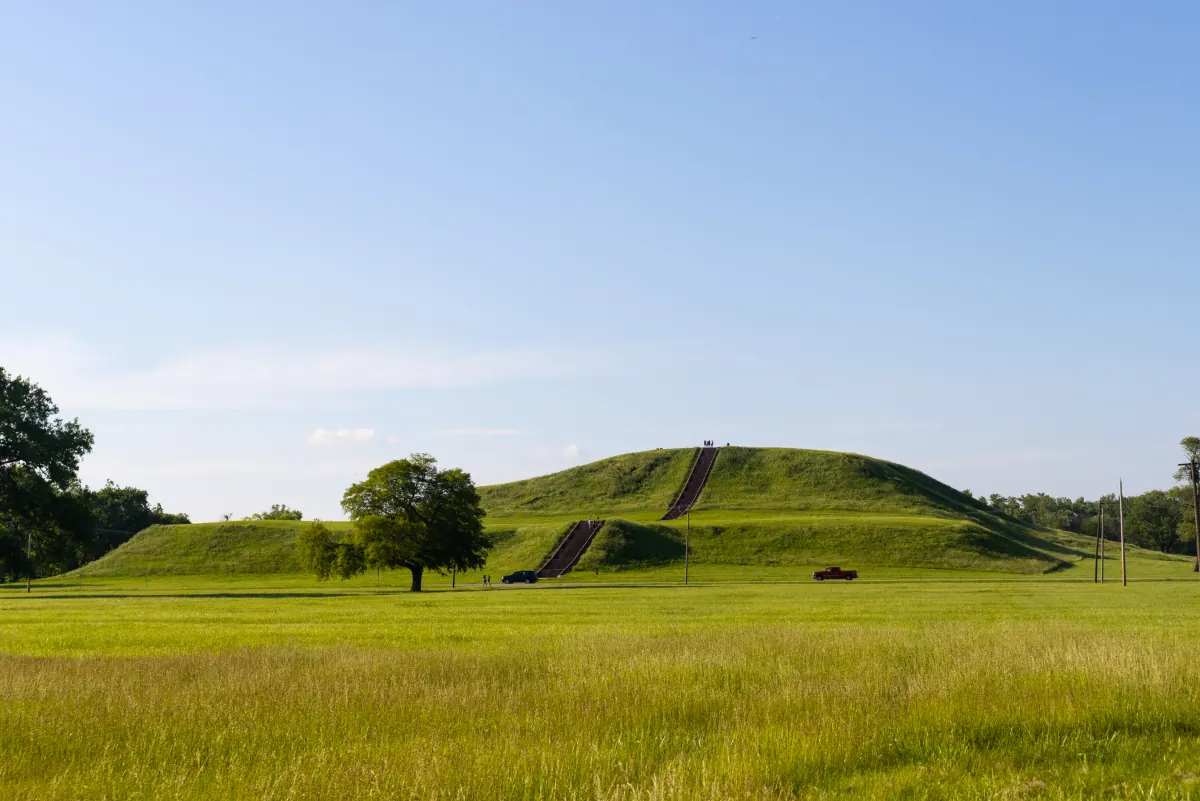
Largest known pre-Columbian city north of Mexico, organised around neighbourhoods, plazas, timber monuments, and immense earthworks including Monks Mound.
Around 1050 CE, a settlement on the rich floodplain east of the Mississippi River changed with remarkable speed. Houses multiplied, immense earthen mounds rose above open plazas, and people arrived from surrounding regions. At its height, Cahokia held perhaps 10,000 to 20,000 inhabitants, making it the largest known pre-Columbian settlement north of Mexico.
The site lies near present-day St. Louis, but the modern skyline gives little sense of the world that once surrounded it. Cahokia was the centre of a much broader landscape of farming communities, satellite settlements, waterways, and ceremonial places. Its residents built in earth, timber, thatch, and clay. Because those materials weather differently from stone, the city can appear emptier today than it was.
Building a city from earth
Cahokia originally contained around 120 mounds spread across an area of nearly sixteen square kilometres. They did not all have the same form or use. Flat-topped platform mounds supported buildings. Conical mounds were often associated with burials. Ridgetop mounds formed long raised crests. Their positions helped organise neighbourhoods, plazas, ceremonial areas, and lines of movement through the city.
Monks Mound dominates the centre. Built in stages from carefully carried loads of soil, it rises about thirty metres and covers more than five hectares at its base. A large structure once stood on its summit. The mound is sometimes called a pyramid because of its stepped profile, but it was an earthen platform rather than a stone-built pyramid like those in Egypt or Mesoamerica.
Its scale required planning and collective labour. Different soils were selected and placed to create fills, surfaces, and slopes, although water moving through the mound has caused slumping both in antiquity and in modern times. Every basket of earth was carried without wheeled carts or draft animals. The monument measures political organisation in human effort.
South of Monks Mound lay the Grand Plaza, an extensive level space reshaped from the natural terrain. It could hold gatherings, ceremonies, games, and public events. A timber palisade enclosed part of the central precinct at different periods, suggesting that boundaries, defence, and controlled access became important as the city developed.
The city beyond the monuments
Most Cahokians did not live on mounds. They occupied neighbourhoods of pole-and-thatch houses arranged around courtyards and work areas. Archaeologists have found storage buildings, pits, workshops, refuse, food remains, tools, and traces of repeated rebuilding. These ordinary features are essential evidence for the people who cooked, farmed, repaired homes, raised children, and supplied large ceremonies.
Cahokia depended on productive fields but not on maize alone. Maize became increasingly important, while farmers also cultivated plants with much older regional histories, including sunflower, goosefoot, maygrass, and knotweed. Fishing, hunting, gathering, and exchange added to the food supply. The surrounding wetlands and river channels offered transport and resources as well as the danger of flooding.
Objects and raw materials travelled to Cahokia from distant parts of North America. Marine shell, copper, stone, and other goods were transformed into ornaments and ceremonial objects. Movement worked in both directions: people, practices, and Cahokian styles reached communities well beyond the city.
Several large circles of timber posts have been reconstructed west of Monks Mound and are now known as Woodhenge. Some alignments mark positions of the rising sun at important points in the year. They may have helped structure a ceremonial calendar, but it is safer to see them as part of a changing public landscape than as a single-purpose observatory.
Power had a human cost
Cahokia's monuments reveal cooperation, but they also raise questions about inequality and coercion. Elaborate burials, special objects, controlled spaces, and evidence of violence show that life in the city was not an uncomplicated communal project. One famous mound, Mound 72, contained several burial episodes, including people who appear to have been sacrificed. Interpretations have changed as older excavations and assumptions are reassessed, but the evidence points to sharp differences in status and power.
The city's population was also diverse. Scientific analyses and artefacts indicate that some residents had grown up elsewhere. Immigration helped create Cahokia's rapid expansion, bringing people with different backgrounds into a new urban order. That movement makes the city less isolated and more dynamic than older accounts allowed.
Decline was movement, not disappearance
Cahokia's population began to fall after its 12th-century peak, and by the 14th century the urban centre was largely depopulated. There is no single proven cause. Floods, drought, pressure on wood and food supplies, political conflict, disease, social tension, and changing regional relationships have all been investigated. Different pressures may have operated at different times.
The people did not vanish. Communities moved, reorganised, and carried knowledge into other Indigenous societies. Many Native nations have historical and cultural interests in the site, even though archaeology cannot assign the entire city's population to one modern nation. Presenting Cahokia as a mysterious lost race repeats an old colonial refusal to recognise Indigenous urban achievement.
Modern development destroyed or isolated parts of the wider settlement before strong protection existed. Roads and buildings now cut through the ancient landscape, while the preserved state historic site protects Monks Mound, the Grand Plaza, and dozens of other mounds. What survives is enough to overturn a persistent misconception: North America before European colonisation had large, planned, politically complex cities, and Cahokia was the greatest of them known north of Mexico.