
Daisen Kofun
Enormous keyhole-shaped burial mound traditionally associated with Emperor Nintoku. Three moats surround it, and restricted access has left much of its interior unexcavated.
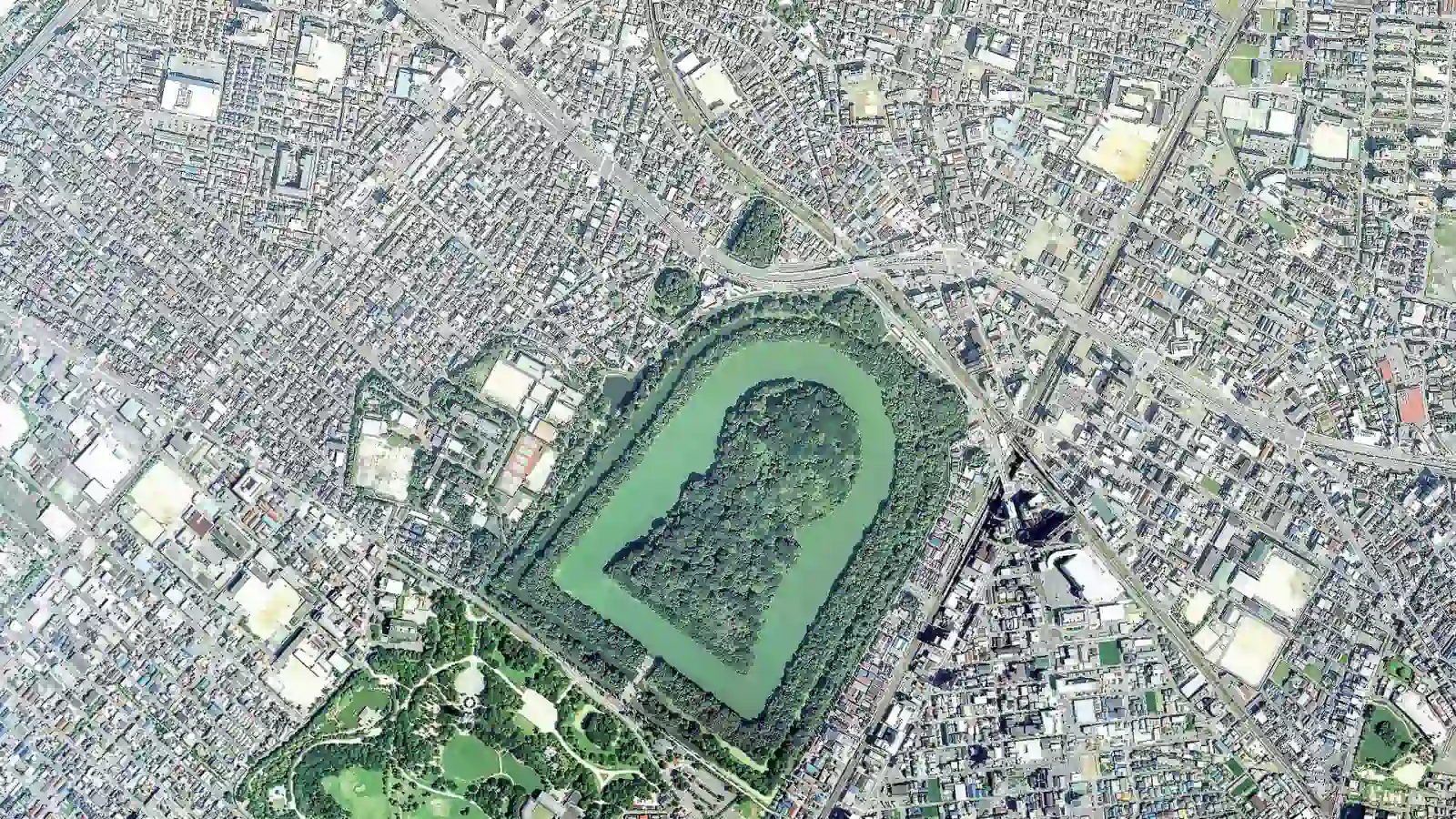
From the ground, Daisen Kofun looks like a wooded island behind a moat. Its full form appears only from above: a circular mound joined to a broad rectangular platform, producing the keyhole outline characteristic of Japan's largest elite tombs. Modern Sakai surrounds it on every side, making the green monument seem almost improbable within the Osaka urban plain.
The mound is also called Daisenryo Kofun and Nintoku-tenno-ryo Kofun. Japan's Imperial Household Agency manages it as the mausoleum of Emperor Nintoku, a ruler remembered in early chronicles. That attribution is traditional, not archaeologically confirmed. Access to the burial area is tightly restricted, so the identity of the person or people interred within remains uncertain.
A mound on an extraordinary scale
Daisen Kofun was built in the middle of the fifth century CE. The earthen mound is about 486 metres long, making it the largest kofun in Japan and one of the largest burial monuments ever constructed. Three moats surround it. Smaller satellite tombs once formed a wider mortuary setting, and more than ten remain around the main enclosure.
The word kofun means “old mound” and gives its name to the Kofun period, usually dated from the third to the sixth century CE. Elite tombs took several forms, including circular, square and scallop-shaped mounds. The largest used the keyhole plan known in Japanese as zenpokoenfun, a square front joined to a round rear when seen from above.
Builders shaped immense quantities of earth into terraces. Stone paving called fukiishi reinforced and defined slopes at many kofun. Rows of clay haniwa were placed on mound surfaces and included cylinders as well as houses, equipment, animals and human figures. Because the centre of Daisen remains inaccessible, details from better-excavated mounds help scholars interpret its missing or hidden features, but they should not be transferred to it without evidence.
What the monument says about power
No ruler could build a mound of this size alone. Earth had to be dug, carried, compacted and shaped. Moats had to be excavated and managed, surfaces finished, objects produced and ceremonies organised. The project speaks to a society capable of mobilising labour and resources across a wide region.
That society was not yet the fully centralised Japanese state known from later written history. The Kofun period saw powerful kin groups competing, forming alliances and establishing hierarchies across the archipelago. Large mounds clustered in places such as Mozu and Furuichi show where leading groups displayed authority through burial.
Connections extended beyond Japan. Grave goods from Kofun-period tombs include weapons, armour, horse equipment, ornaments and technologies associated with exchange across the Korean Peninsula and East Asia. The mounds themselves are distinctly Japanese constructions, but the society that built them participated in a mobile regional world.
The problem of a closed tomb
In 1872, part of Daisen Kofun was disturbed accidentally. A stone coffin, armour and other objects were reportedly found and then reburied. Drawings made at the time preserve some information, but the episode did not become a modern scientific excavation.
Imperial mausolea are treated as sacred ancestral sites, and research access has long been limited. Restricted entry protects the mound from heavy disturbance and casual tourism. It also prevents archaeologists from testing chronology, burial structure and occupant identity as thoroughly as they can at open sites.
Small investigations and collaborative surveys have gradually increased knowledge around imperial tombs, yet the central chamber of Daisen has not supplied evidence that can securely name its occupant. Early Japanese chronicles were compiled centuries after the mound was built. Their royal genealogies are historically important, but matching a named emperor to a particular fifth-century tomb requires more than tradition.
The careful wording is therefore simple: Daisen Kofun is traditionally associated with Emperor Nintoku. Calling it “Emperor Nintoku's tomb” as a proven fact closes a question that archaeology has not settled.
One mound within a funerary landscape
Daisen belongs to the Mozu-Furuichi Kofun Group, inscribed by UNESCO in 2019. The World Heritage property contains 49 mounds in 45 components selected from two great clusters. Together they preserve changes in size, shape and rank during the height of the Kofun period.
Urban growth has transformed their setting. Roads, houses and railway lines press close to surviving moats. Some smaller mounds disappeared as the Osaka region expanded. Water management, vegetation, earthquakes and the visual impact of new construction all require attention. The wooded surfaces familiar today are also later landscapes; they can conceal erosion and obscure the terraced form.
Public viewing is limited to designated points outside the moat. Maps, museum models and aerial photographs therefore explain a shape that the surrounding streets cannot reveal in full.
From street level, the monument withholds its design. That limited view is appropriate in an unexpected way. Daisen Kofun is both highly visible and largely unknown: a vast statement of fifth-century authority whose central archaeological evidence remains out of reach. Its keyhole outline can be mapped precisely, while the person at its heart cannot yet be named with certainty.