
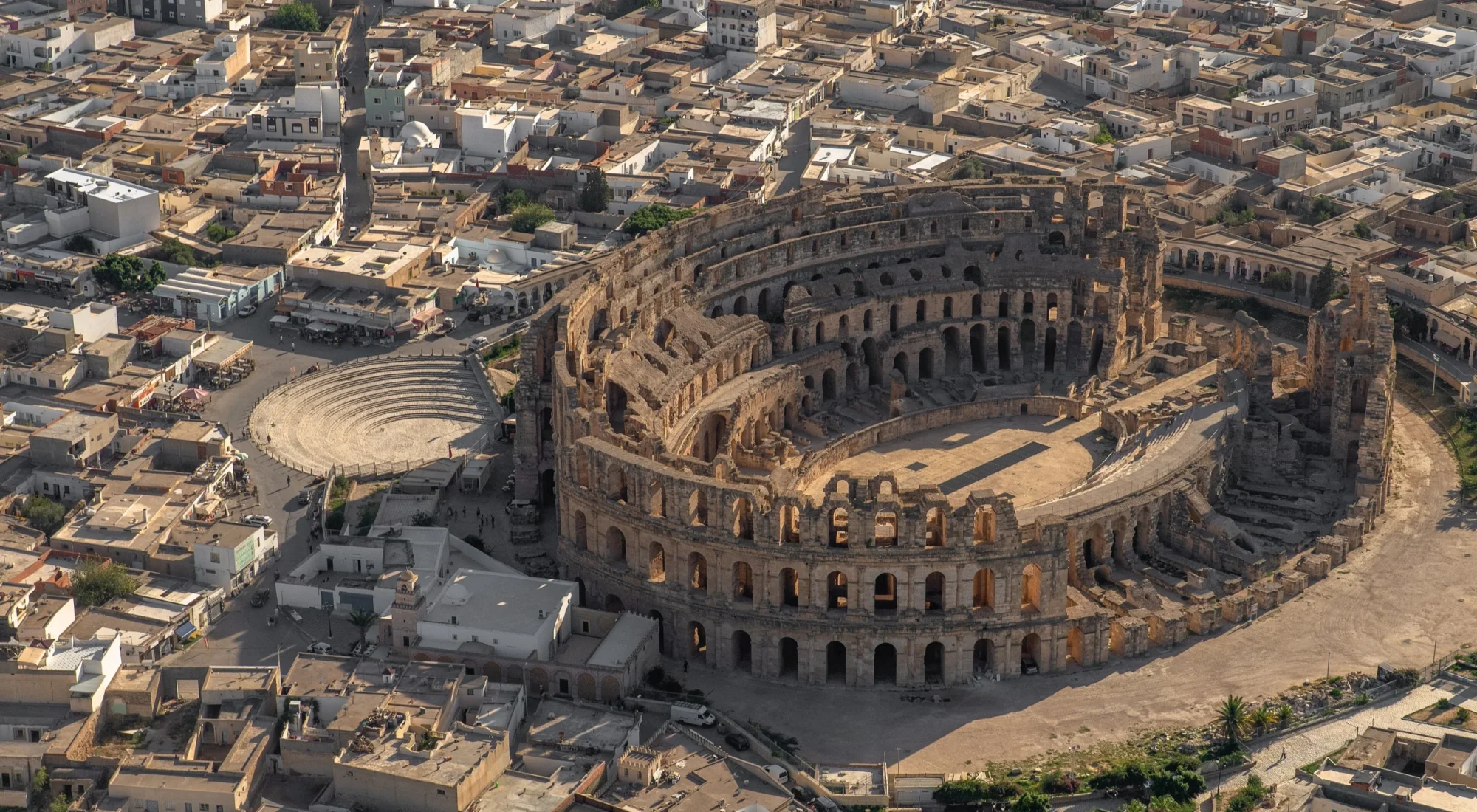
El Djem Amphitheatre
Third-largest Roman amphitheatre, larger than what survives of the Colosseum. Capacity 35,000, in a small town in the Tunisian interior.
The amphitheatre at El Djem does not hide inside a field of ruins. It rises above a living Tunisian town, its arcades visible long before a visitor reaches the ancient arena. The contrast is startling: a building intended for tens of thousands of spectators standing in a place that now feels too small to explain it.
Ancient Thysdrus was not small in the same way. It prospered within Roman Africa, a region whose farms and olive oil helped supply cities across the Mediterranean. The amphitheatre turned some of that wealth into architecture on an imperial scale. It is tempting to call it a copy of Rome's Colosseum. The resemblance is obvious, but El Djem has its own engineering, history and unanswered questions.
Thysdrus before the arena
The Roman city developed on the site of an earlier settlement in the plains of central Tunisia. It occupied a productive agricultural zone and became closely associated with olive cultivation and oil. Mosaics, houses and public buildings found around modern El Djem show that the arena was only one part of a wealthy urban community.
Thysdrus had more than one amphitheatre. Archaeologists have identified earlier, smaller structures, including an arena adapted from a natural depression and a later masonry building. The enormous monument that survives today belongs to the final stage of that local tradition.
This sequence matters because it shows demand growing over time. Spectacle was not imported in a finished architectural package. The city repeatedly changed the spaces in which crowds gathered.
How old is the great amphitheatre?
UNESCO dates the monument to around 238 CE, the year in which a revolt at Thysdrus helped carry the elderly provincial governor Gordian I briefly to the imperial throne. The association is plausible and has become part of the arena's identity.
There is, however, no surviving dedicatory inscription that settles the date or names its patron. Specialists have proposed dates from the late second century into the first half of the third. Architectural arguments often place construction in the 230s, but a direct claim that Gordian personally completed the building goes beyond the evidence.
The uncertainty makes the arena more revealing, not less. Whoever commissioned it expected Thysdrus to support a monument almost equal in scale to the most ambitious amphitheatres of the empire.
A freestanding mountain of stone
The outer ellipse measures roughly 148 by 122 metres. UNESCO estimates a capacity of about 35,000 spectators. Three surviving levels of arcades use Corinthian and composite forms, while a dense interior system of corridors, stairways and supports once moved the crowd to different seating zones.
Unlike amphitheatres built into a hillside, El Djem stands on flat ground. Its seating was carried by the building itself. The structure is made from large cut-stone blocks and is freestanding, without conventional deep foundations. That choice demanded careful distribution of weight through walls, vaults and piers.
Research into the stone has traced material to ancient quarries around 30 kilometres from Thysdrus. Transporting and raising those blocks was an achievement involving quarry workers, hauliers, masons, engineers and a substantial financial network. The finished facade advertised far more than entertainment. It made the resources and confidence of the city visible across the plain.
Below the arena floor
The oval arena was the stage for public spectacles, including gladiatorial combat and hunts involving animals. Beneath it, two long underground galleries and associated rooms survive unusually well. Openings connected the service level with the floor above, allowing people, equipment and animals to enter the spectacle at planned moments.
We should be cautious about filling every chamber with a dramatic story. The architecture shows how movement was organised, but it does not preserve a schedule of individual events. Amphitheatres could host ceremonies, punishments and different forms of performance as well as the combats that dominate modern imagination.
The seating also made Roman society visible. Routes and barriers directed spectators according to status. A crowd watched the arena, but it also watched an ordered image of itself arranged around the ellipse.
The building after Rome
The amphitheatre survived because later communities continued to find uses for it. Its walls offered refuge and defensive strength, while its cut stone could be reused in other construction. Sections of the outer wall were lost, but much of the supporting structure, podium, arena and underground system remained.
Reuse is sometimes presented only as destruction. It is also part of the monument's history. El Djem was not sealed when ancient spectacles ended. The building became a landmark, a source of material, a stronghold and eventually a protected archaeological monument within an inhabited town.
Modern conservation has to manage that relationship. New construction can affect the arena's setting, while tourism and events bring people back into a structure never designed for modern safety requirements. Repairs must stabilise stone without smoothing away evidence of age and alteration.
Why the comparison with Rome falls short
The amphitheatre was inscribed on the UNESCO World Heritage List in 1979. It is one of the best-preserved large Roman arenas and the largest surviving amphitheatre in North Africa. Those comparisons are useful, but they can keep the building in Rome's shadow.
El Djem is better understood as evidence for the prosperity and ambition of Roman Africa. Its builders adapted a widely recognised architectural form to the resources of Thysdrus. Its crowds gathered in a provincial city that was not peripheral to the empire's economy, even if it was distant from the capital.
The arena looks oversized only when the ancient city around it disappears from view. Put Thysdrus back into the picture, with its agriculture, houses, mosaics, workshops and regional connections, and the scale begins to make sense.
Sources
- UNESCO World Heritage Centre: Amphitheatre of El Jem
- ICOMOS: Amphitheatre of El Jem advisory evaluation
- Princeton Encyclopedia of Classical Sites: Thysdrus
- Jean-Claude Golvin and Mongi Khanoussi: “Les amphithéâtres d'El-Jem”
- H. Younes and colleagues: building stone of the Thysdrus and Thapsus amphitheatres