
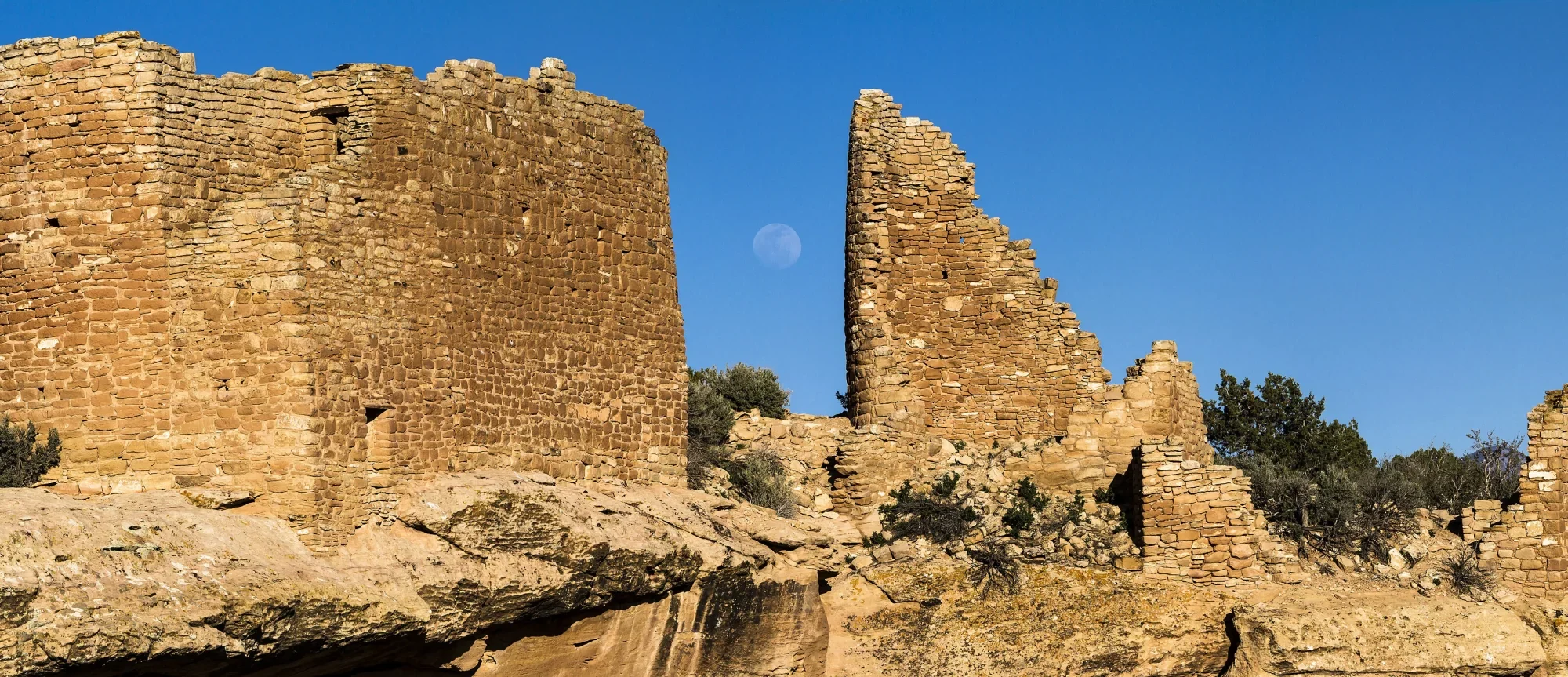
Hovenweep
Ancestral Puebloan towers on the Utah-Colorado border. Oriented to track solstices through tiny portholes.
Stone towers rise from the canyon rims at Hovenweep. Some are square, some round, and others follow the irregular shape of the boulders beneath them. From a distance they look defensive, like watchtowers guarding a frontier. Up close, that explanation becomes less certain. Openings face springs, sunlight enters selected rooms, and towers connect to houses and ceremonial spaces in ways that do not fit a single military purpose.
Hovenweep is not one ruined village. It is six groups of Ancestral Pueblo buildings spread across what is now the Utah-Colorado border. The towers are its most visible puzzle, but the wider landscape of fields, water, canyons and routes between communities is the better place to look for answers.
Six communities, not one fortress
The national monument protects the Square Tower, Cajon, Holly, Horseshoe and Hackberry, Cutthroat Castle and Goodman Point groups. Most of the standing architecture dates between about 1200 and 1300 CE, although people had visited and lived in the region for thousands of years before those towers were built.
The inhabitants were part of the Ancestral Pueblo world of the Four Corners. Similarities in masonry, pottery and settlement patterns connect Hovenweep with communities around Mesa Verde and elsewhere on the Great Sage Plain. Today's Pueblo, Hopi and Zuni peoples are among the descendants of those communities. Ute, Paiute, Navajo and other Native nations also have long relationships with this landscape.
Calling Hovenweep “abandoned” can therefore mislead. People migrated from the settlements, but the places did not lose cultural meaning. Descendant communities continue to regard them as ancestral homes and locations of prayer.
Building where water reached the surface
Many Hovenweep settlements stand at canyon heads near springs and seeps. The geology helps explain why. Porous Dakota sandstone absorbs rain until the water reaches denser rock below. Unable to travel farther downward, it moves sideways and emerges at a canyon edge.
In a high-desert environment, those springs mattered. Ancestral Pueblo farmers grew maize, beans and squash while managing uncertain rainfall. They built terraces and check dams to slow runoff, protect soil and retain moisture. Fields extended well beyond the stone structures that survive so dramatically today.
The towers were therefore part of working agricultural communities, not isolated monuments. Room blocks, kivas, storage spaces, plazas, reservoirs and field systems reveal daily life around them.
Round, square and fitted to the rock
Hovenweep's masons shaped sandstone blocks and used smaller stones set in mortar to fill the spaces between them. Some walls still rise several storeys. Square Tower was constructed on a boulder below the canyon rim, while Hovenweep Castle combines room blocks and D-shaped towers above it. Twin Towers demonstrates how carefully builders adjusted walls to an irregular foundation.
No single explanation accounts for every tower. Proposed uses include storage, observation, ceremony, defence and control of access to water. Some buildings may have served several purposes, or changed function during their use.
The National Park Service also records alignments involving portholes, rock art and the movement of the sun. At particular structures, shafts of light or sightlines mark seasonal events such as solstices. That does not mean every doorway is an astronomical instrument. The careful examples show that builders paid attention to solar cycles within a landscape where agricultural and ceremonial calendars mattered.
Drought, prayer and migration
The major towers were built during a period of environmental and social pressure. Drought affected the region in the late twelfth and thirteenth centuries. Farming communities responded with water-control measures, food storage, movement between settlements and ceremonial practices.
Consultation with descendant communities has added perspectives that archaeology alone cannot provide. Some tribal consultants suggest that canyon-head structures near springs were places where prayers for moisture could travel through connected waters, while buildings on the rims looked toward mountains associated with rain.
By the end of the thirteenth century, families had moved south and east toward growing Pueblo communities along the Rio Grande and on the Hopi mesas. There was no single night when Hovenweep “vanished.” Migration unfolded over generations amid drought, resource stress, changing relationships and choices about where a community could live well.
That history belongs to the continuing story of Pueblo peoples, not to a tale of a mysteriously disappeared civilisation.
A name that needs explanation
The word Hovenweep has been translated from a Ute or Paiute term as “deserted valley.” Photographer William Henry Jackson used it for the ruins in 1874. The National Park Service now notes the tension in that name: Native people knew the places before nineteenth-century explorers wrote about them and did not regard the canyons as empty of history or presence.
Smithsonian archaeologist Jesse Walter Fewkes surveyed structures here in 1917 and 1918 and argued for their protection. Hovenweep National Monument was established in 1923. Goodman Point had already become the first archaeological area reserved by the federal government in 1889 and was later incorporated into the monument.
Protection now extends beyond keeping walls upright. Springs, soils, views, archaeological deposits and relationships with affiliated tribes are all part of the cultural landscape. Stabilisation must preserve original masonry without turning the towers into rebuilt stage sets.
Hovenweep's towers remain compelling because their purpose cannot be reduced to one label. They belonged to homes, farms, ceremonies and a network of communities. The uncertainty is not a failure of archaeology. It is evidence that these buildings participated in lives more complicated than the word “tower” suggests.