Hypogeum of Ħal Saflieni
Three-level subterranean necropolis carved entirely by hand from limestone. Acoustic chambers tuned to specific frequencies.
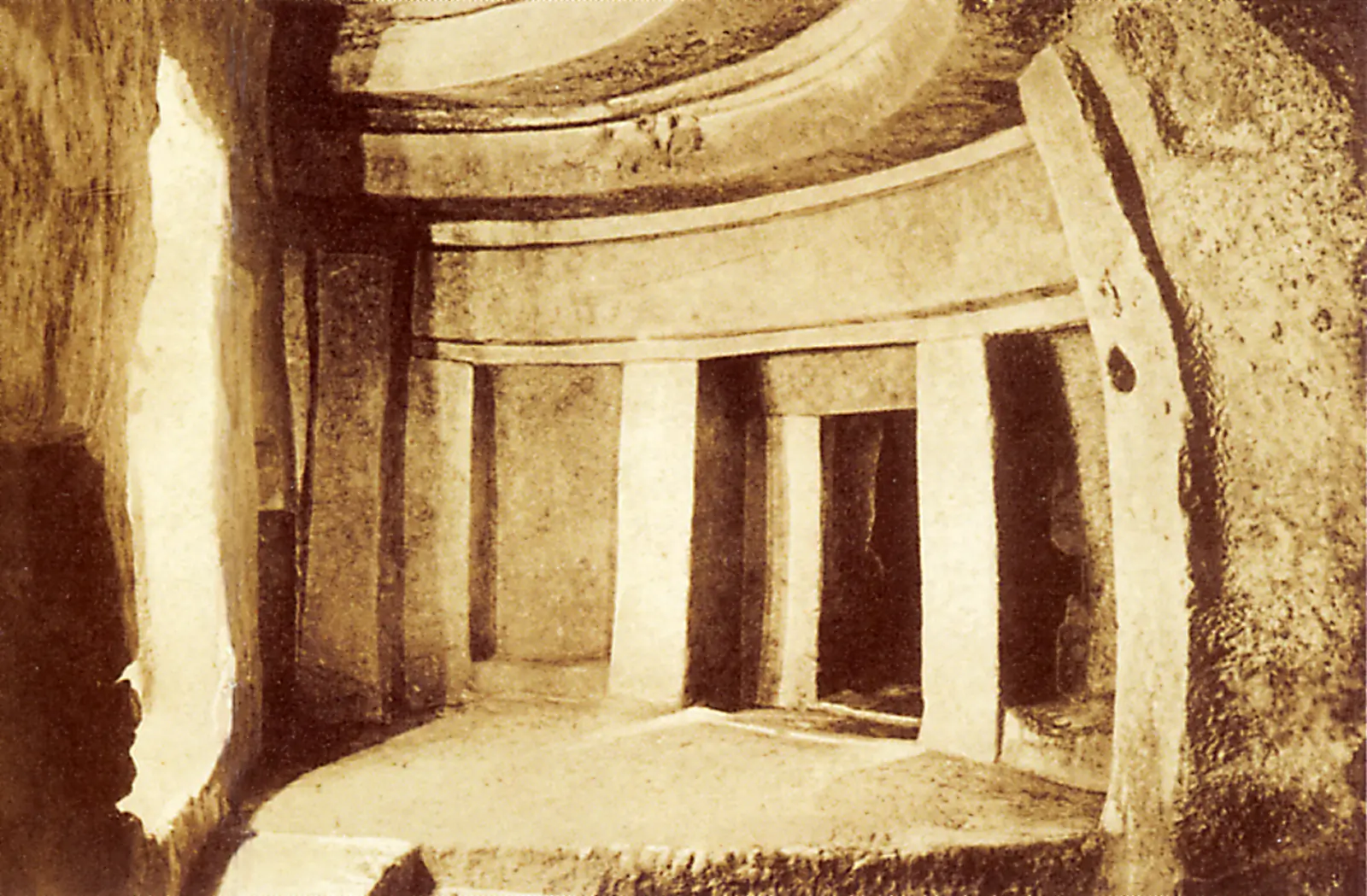
From the street in Paola, the Ħal Saflieni Hypogeum gives little away. Its chambers lie beneath modern buildings on a hill overlooking Malta’s Grand Harbour. Inside, stairs descend through three levels of rooms cut from soft limestone. Doorways lead to further doorways. Curving walls imitate built masonry, even though the chambers were carved directly from the rock.
The complex served as a communal burial place during Malta’s Neolithic period, roughly between 4000 and 2500 BCE. Human remains from thousands of individuals accumulated there alongside pottery, ornaments, pigments and figurines. The monument was expanded downward over centuries, as new generations returned to work within a place already filled with their dead.
Its survival owes much to chance. A stonemason discovered the chambers in 1902 while foundations were being cut for houses. By the time the authorities received a report, construction above had already damaged much of the upper level. Excavation continued until 1911, leaving records and collections that researchers still reassess.
Three levels cut into a hill
The upper level began as a natural hollow adapted for burial. Chambers were cut into its sides, and an entrance structure once stood at ground level. Only fragments of that building survive, so its original appearance remains uncertain.
As space became limited, the people using the Hypogeum excavated deeper. The middle level contains the most elaborate architecture. Walls, openings and ceilings were shaped to recall the interiors of Malta’s above-ground megalithic temples. Carved bays resemble trilithon doorways. Some ceilings imitate courses of masonry corbelled inward, one ring projecting beyond the one below.
That imitation is one of the site’s most useful pieces of evidence. Roofs rarely survive on Malta’s prehistoric temples, but the carved underground versions suggest how some above-ground interiors may once have been enclosed. The Hypogeum preserves an architectural idea in negative: stone removed from the hill recreates structures that were elsewhere assembled from stone blocks.
The lower level reaches about 10.6 metres below the present street. It contains chambers and niches but yielded little burial material. Its exact use is unclear. Practical work at that depth required artificial light, ventilation and a way to remove spoil through the passages above.
The complex covers about 500 square metres. Its modest footprint can feel much larger because spaces turn, narrow and overlap vertically. “Labyrinth” is a tempting word, but there is no evidence that the builders intended to confuse visitors. The plan grew through repeated excavation, following the needs and decisions of communities over many centuries.
What happened to the bodies
UNESCO’s account estimates that the Hypogeum originally held the remains of about 7,000 people. They were not placed in neat individual graves. Bones accumulated together, and the archaeological evidence suggests that burial could involve more than one stage. A body may first have decomposed elsewhere or within an accessible area before selected remains were gathered into the chambers.
Red ochre occurs with the bones and on some walls and ceilings. Spirals and honeycomb-like painted designs are the only known prehistoric wall paintings in the Maltese Islands. Ochre may have carried associations with blood, life or transformation, but no text records what the colour meant to the people who used it.
Objects accompanied the dead. Archaeologists recovered decorated pottery, shell buttons, beads, amulets and small carvings of animals and people. The most famous is a clay figurine popularly called the “Sleeping Lady,” showing a reclining figure on a couch or bed. It is often labelled a goddess in popular retellings. The object itself does not identify the person represented or prove a specific deity.
Human remains offer another path into the community. They can reveal age, health, diet, mobility and burial practice, although early excavation and the mixing of bones complicate reconstruction. The number of individuals shows long use, not a single catastrophe.
The echo in the so-called Oracle Chamber
One decorated room contains a small niche that produces a noticeable echo when someone speaks into it. This acoustic effect has encouraged stories about priests, altered consciousness and hidden sound technology. The room is often called the Oracle Chamber, a modern name that can make speculation sound like an ancient fact.
The echo is real. Its original purpose is unknown. It may have been noticed and used during ceremonies, or it may be an unintended result of the chamber’s shape and stone surfaces. Responsible interpretation can hold both possibilities without inventing a ritual.
Sound would nevertheless have mattered underground. Voices, footsteps and light behave differently in confined chambers. People working or conducting funerary acts in the Hypogeum experienced architecture through the body, not through a plan. The darkness and acoustics are part of the site, even where their meaning remains beyond recovery.
A monument that must breathe carefully
The same enclosed environment that preserved the Hypogeum makes it fragile. Visitors add heat, humidity, carbon dioxide and micro-organisms. Water can enter from streets and services above. Artificial lighting may encourage biological growth, while changes in temperature and relative humidity affect painted and carved surfaces.
The site spent years closed while its environment was studied and controlled. Houses directly above parts of the monument were acquired and removed. Visitor numbers and light levels were restricted. More recent conservation installed improved insulation, repaired water and sewer connections, and introduced a system designed to keep temperature and humidity stable.
These measures explain why access is limited to small groups. The restriction is not theatrical exclusivity. It is part of preserving surfaces that cannot be replaced once they flake or erode.
The Hypogeum remains powerful without a claim that every chamber has been decoded. Its evidence is more intimate than certainty: a tool mark in soft limestone, red pigment on a ceiling, bones gathered by repeated hands, and architecture copied underground from buildings that have lost their roofs. Those traces bring prehistoric Malta close while keeping its beliefs honestly out of reach.