
Lalibela
Eleven churches hewn downward from solid rock. Connected by a network of tunnels and trenches still in liturgical use.
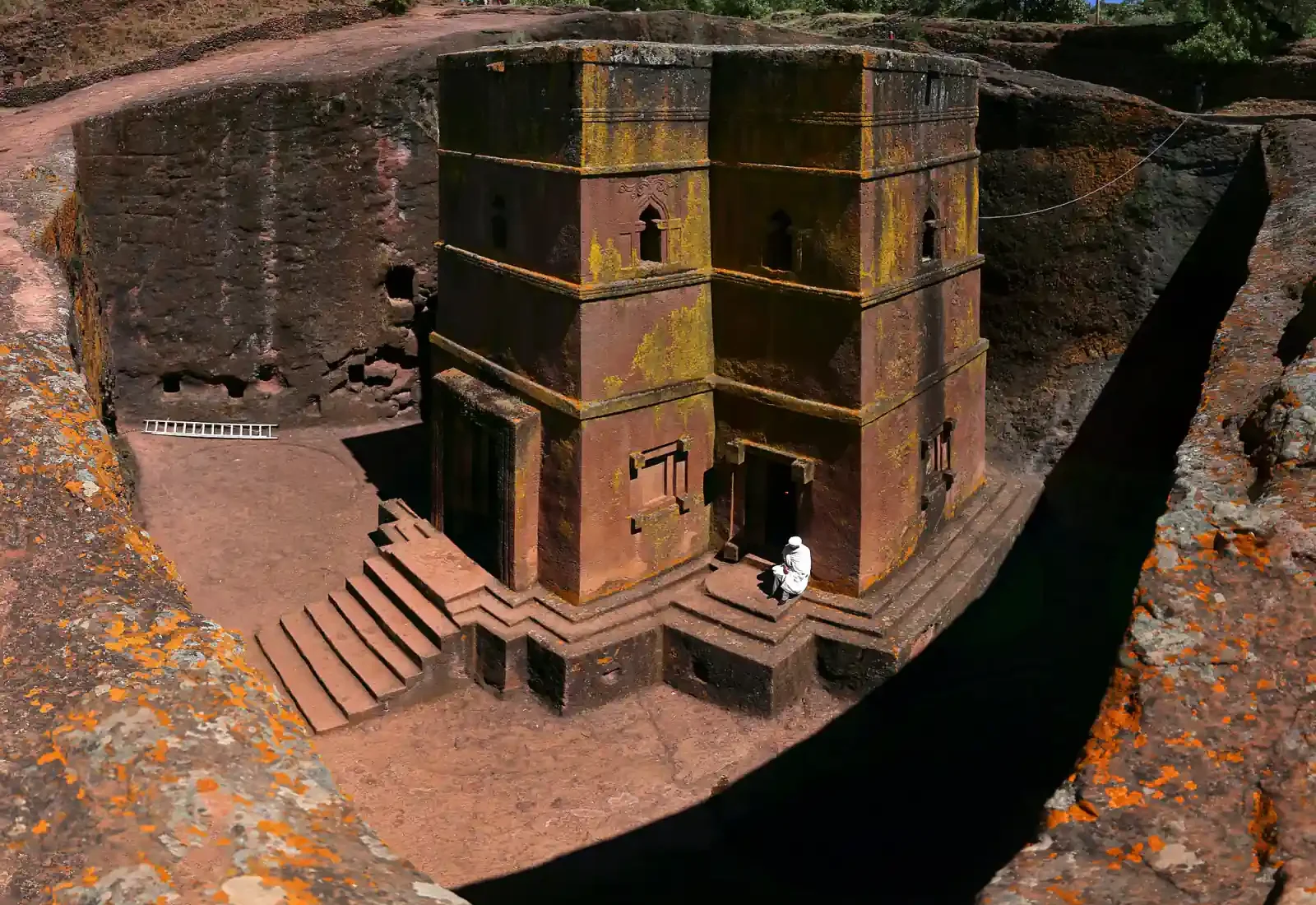
The roof of Biete Ghiorgis lies almost level with the surrounding ground. Its cross-shaped plan becomes visible only at the edge of a deep trench, where the church stands free from the rock that once enclosed it. Steps descend to doors and passages below. Elsewhere in Lalibela, courtyards, tunnels and narrow cuts connect another ten churches across the red volcanic hillside.
These buildings are regularly called rock-hewn churches, but the phrase covers several methods. Some were cut as monolithic blocks, separated from the bedrock on all sides and hollowed within. Others remain attached to the surrounding rock or incorporate caves and constructed masonry. The result is an architectural landscape made by removing material, planning empty space as carefully as walls.
Lalibela is also a living sacred place. Priests, monks, worshippers and pilgrims use the churches throughout the year. Any account that treats them only as medieval engineering leaves out the people who have sustained their religious life for centuries.
A royal project and a New Jerusalem
Tradition attributes the complex to King Lalibela of the Zagwe dynasty, usually placed in the late twelfth and early thirteenth centuries. According to this understanding, the king sought to create a New Jerusalem in the Ethiopian highlands. Names throughout the site reinforce the association: a channel called the River Jordan separates the principal groups, while Golgotha and the Tomb of Adam evoke places in the Holy Land.
The tradition is central to Lalibela's identity, yet the precise chronology is less secure than a single reign suggests. Buildings could have developed through several campaigns, and later communities repaired, altered and redecorated them. Some spaces may have served other functions before becoming churches. UNESCO notes, for example, that Biete Mercoreos and Biete Gabriel Raphael may once have been connected to royal residence.
Eleven churches form the recognised group. North of the Jordan are Biete Medhani Alem, Biete Mariam, Biete Maskal, Biete Denagel and Biete Golgotha Mikael. The southern group includes Biete Amanuel, Biete Qeddus Mercoreus, Biete Abba Libanos, Biete Gabriel Raphael and Biete Lehem. Biete Ghiorgis stands apart but connects to the complex through trenches and passages.
Architecture made through excavation
Building downward changed the order of construction. Craftspeople first had to define a church from above, cutting trenches around a mass of rock. They could then shape exterior walls, roofs, windows and columns before hollowing interiors. Errors could not be corrected by replacing a block. Cracks, water flow and the natural structure of the tuff all had to be understood as work progressed.
Biete Medhani Alem has five aisles and is often described as the largest monolithic church in the world. Biete Ghiorgis is the most immediately legible from above, but each building solves a different structural problem. Carved pillars support ceilings. Doors and windows imitate forms familiar from constructed architecture. Ceremonial passages, hermit cells and catacombs extend the sacred topography beyond the main interiors.
Drainage was part of the original concept. Rainwater had to be carried away from roofs and sunken courtyards. When channels filled with earth over later centuries, water began entering porous stone and flowing down carved surfaces. This is one reason that conservation cannot focus on façades alone. The whole excavated landscape acts as a connected water system.
Worship has never become an exhibit
The churches remain part of Ethiopian Orthodox Christian life. Clergy conduct daily services, and major feasts draw pilgrims from across Ethiopia and beyond. During Genna, Ethiopian Christmas, white-clad worshippers fill the courts and passages. Manuscripts, crosses, processions, chanting and the rhythms of prayer give the site meanings that archaeology cannot recover from stone by itself.
Living use creates responsibilities as well as continuity. Conservation work must allow worship to continue and involve the religious community in decisions. A repair that protects a wall but blocks a procession route, changes the acoustic character of a church or removes a valued surface can damage what it intends to preserve.
The traditional circular houses around the churches also belong to Lalibela's historic setting. UNESCO identifies their relationship with the sacred complex as part of the property's significance. Urban growth, tourism infrastructure and new construction can weaken that relationship even when they do not touch a church directly.
Protecting stone from water and time
The volcanic rock is vulnerable to rain, moisture, biological growth and temperature changes. Wall surfaces crumble, paintings deteriorate and cracks threaten structural stability. Large temporary shelters were erected over several churches in 2007. They reduce direct rainfall but are visually intrusive and do not solve drainage or deterioration across the uncovered parts of the complex.
World Monuments Fund and UNESCO developed a different approach at Biete Gabriel Raphael and later at Biete Golgotha Mikael. Work combined documentation, structural analysis, roof drainage, lime-based repairs and training for local craftspeople. The aim was to develop methods that could be maintained locally and adapted to other churches.
There is no final state to which Lalibela can simply be returned. The churches have been used, repaired and understood across generations. Their future depends on balancing fragile material, religious practice, local livelihoods and the pressure of global attention. Carving churches from a mountain was an extraordinary achievement. Eight centuries of worship have made those excavated spaces something greater than a feat of construction.