
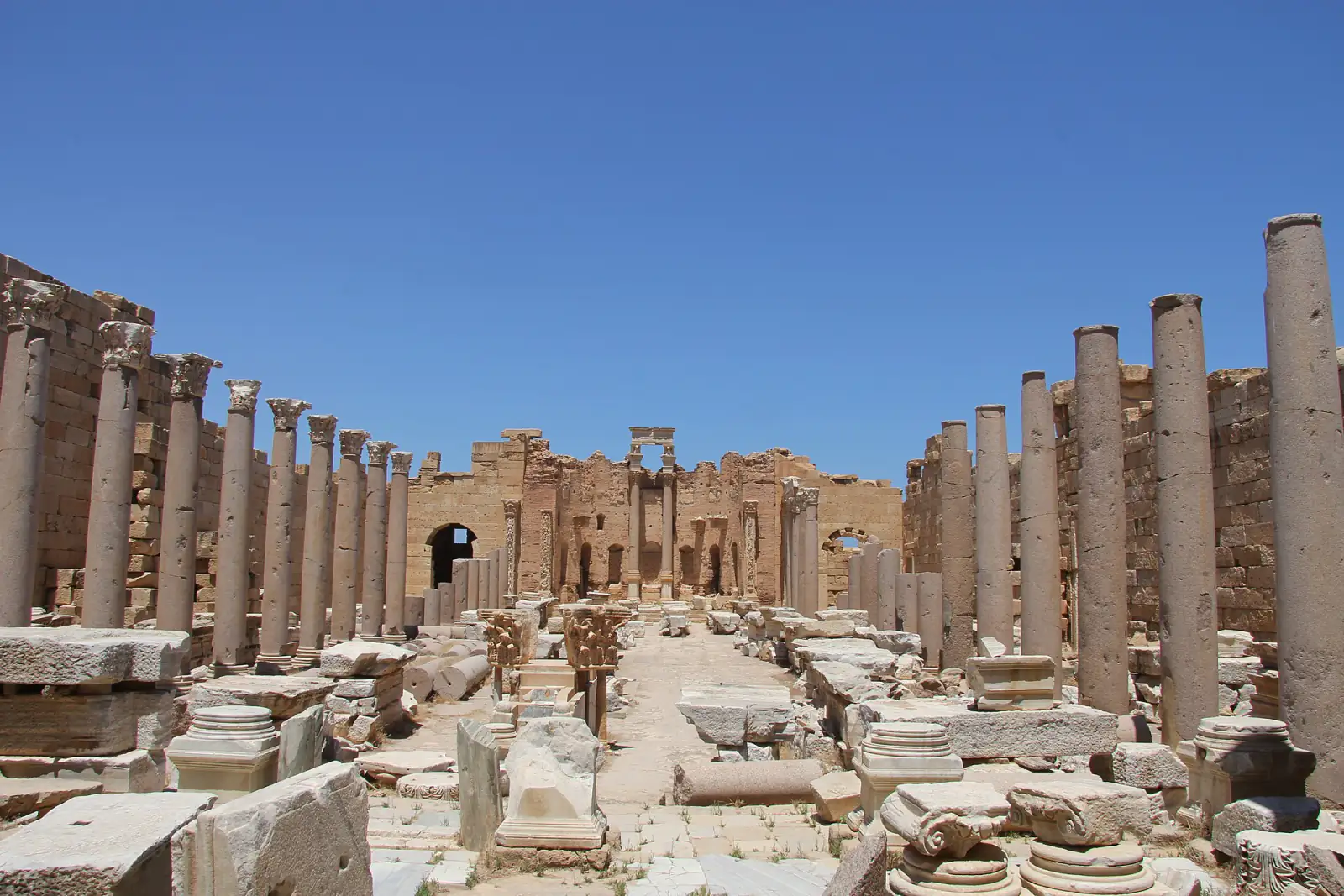
Leptis Magna
Roman city under emperor Septimius Severus, who was born there. Spectacularly preserved, with security concerns limiting visitors.
Columns line a broad street leading toward the Mediterranean, but the sea no longer reaches the harbour built to receive it. Sand and sediment altered the coastline, while the ruins of forums, baths, markets and houses survived inland. At Leptis Magna, an unusually complete Roman city stands above earlier Punic foundations on the coast of modern Libya.
Its fame is tied to Septimius Severus, the emperor born here in 145 CE. He lavished imperial building on his home city, giving it a new forum, basilica, ceremonial arch and monumental route to the port. Yet Leptis existed for centuries before Severus, and it continued after his dynasty. Reading the site through one emperor alone hides the merchants, craftspeople, sailors, enslaved people and families who made the city function.
A Phoenician port on the North African coast
UNESCO traces the settlement's foundation to Phoenician traders in the seventh century BCE. The position was well chosen. Wadi Lebda reached the sea here, and routes connected the coast to agricultural land and communities farther inland. Leptis belonged to a network of western Phoenician and Punic settlements in which language, religion and commerce linked North Africa with the central Mediterranean.
Carthaginian influence was strong, but local society was not a copy of Carthage. Punic institutions and names persisted after Rome took control of the region. The city became part of the Roman province of Africa, gained municipal status and eventually became a colonia. Its elite adopted Roman political forms while retaining African and Punic connections.
Agricultural wealth supported that ascent. The surrounding region produced grain and especially olive oil, exported through the port. Taxes, trade and landholding paid for public buildings and civic honours. The surviving market, dedicated in the Augustan period and later altered, helps make that economy visible. Its colonnades and shops belong to daily exchange, not simply imperial display.
The Severan transformation
Septimius Severus came to power in 193 CE after a period of civil war. His origins at Leptis Magna gave the city extraordinary access to imperial patronage. A four-sided arch marked the intersection of important streets. A colonnaded avenue led toward an expanded harbour. The new Severan Forum and basilica created a ceremonial centre on a scale suited to an imperial capital.
The architecture did not reproduce Rome exactly. Decorative programmes drew on African, Greek and eastern Mediterranean traditions. Carved pilasters in the basilica carry scrolls and figures with a dense, crisp style. Imported marble advertised long-distance supply and imperial resources, while local limestone and existing streets anchored the new complex in the older city.
The harbour was an engineering project as much as a façade. Its artificial basin covered roughly ten hectares. A barrage and canal were intended to manage the wadi and reduce the movement of sediment. The solution was impressive but never permanent. Silting remained a problem, and changes to the watercourse eventually limited the port.
A city of baths, worship and work
Leptis preserves several urban centres because growth did not erase every earlier one. The Old Forum contains temples and civic buildings with roots before the Severan programme. The theatre, begun in the early imperial period, was built into a low rise. The Hadrianic Baths combined pools, exercise courts and richly faced interiors. An amphitheatre and circus stood beyond the dense centre, where crowds gathered for spectacles and races.
Warehouses, workshops, shops and residential quarters provide a necessary counterweight to monumental architecture. Water supply, drainage and streets reveal organised civic labour. Inscriptions record benefactors, officials and dedications, though the people named in stone represent only a fraction of the population.
Religious life also changed. Punic deities were understood through Roman names and forms, imperial cult occupied public space, and Christianity later reshaped buildings and burial. These transitions were gradual and uneven. A city could acquire new institutions without its residents abandoning every older practice at once.
Decline was a long process
Leptis contracted during late antiquity as trade patterns, political authority and regional security changed. The port's silting reduced one of its advantages. Vandal rule in the fifth century and Byzantine reconquest in the sixth brought further military and administrative change. Some buildings were fortified or reused, while occupation continued on a smaller scale.
The Arab conquest in the seventh century did not cause an inhabited metropolis to vanish overnight. By then Leptis had already lost much of its earlier population and infrastructure. Wind-blown sand covered large areas over the following centuries, helping preserve walls and floors while removing the city from ordinary urban life.
European travellers described the ruins in the seventeenth and eighteenth centuries. Large-scale excavation came in the twentieth century, especially during Italian colonial rule in Libya. Archaeology exposed major monuments and carried out restoration, but that work also belonged to a colonial programme that used Roman remains to support modern political claims. The history of excavation must therefore be read alongside the ancient city.
Heritage in a period of instability
Leptis Magna became a World Heritage Site in 1982 and was placed on the List of World Heritage in Danger in 2016 with Libya's other inscribed properties. Armed conflict, limited staffing, uncontrolled development, weathering and insufficient maintenance all threaten archaeological sites even when no battle reaches their walls.
A joint World Heritage Centre and ICOMOS mission visited Leptis Magna in February 2025 to assess its condition and management needs. Such missions cannot replace permanent local expertise. Libyan archaeologists, guards, conservators and communities carry the daily burden of monitoring an enormous site.
The surviving city is spectacular, but “well preserved” should never imply untouched. Ancient rebuilding, late reuse, sand, excavation and modern restoration all shaped what is visible. Leptis Magna is valuable precisely because those layers still allow a port, a provincial community and an emperor's ambitions to be examined in the same streets.