Pyramids of Meroë
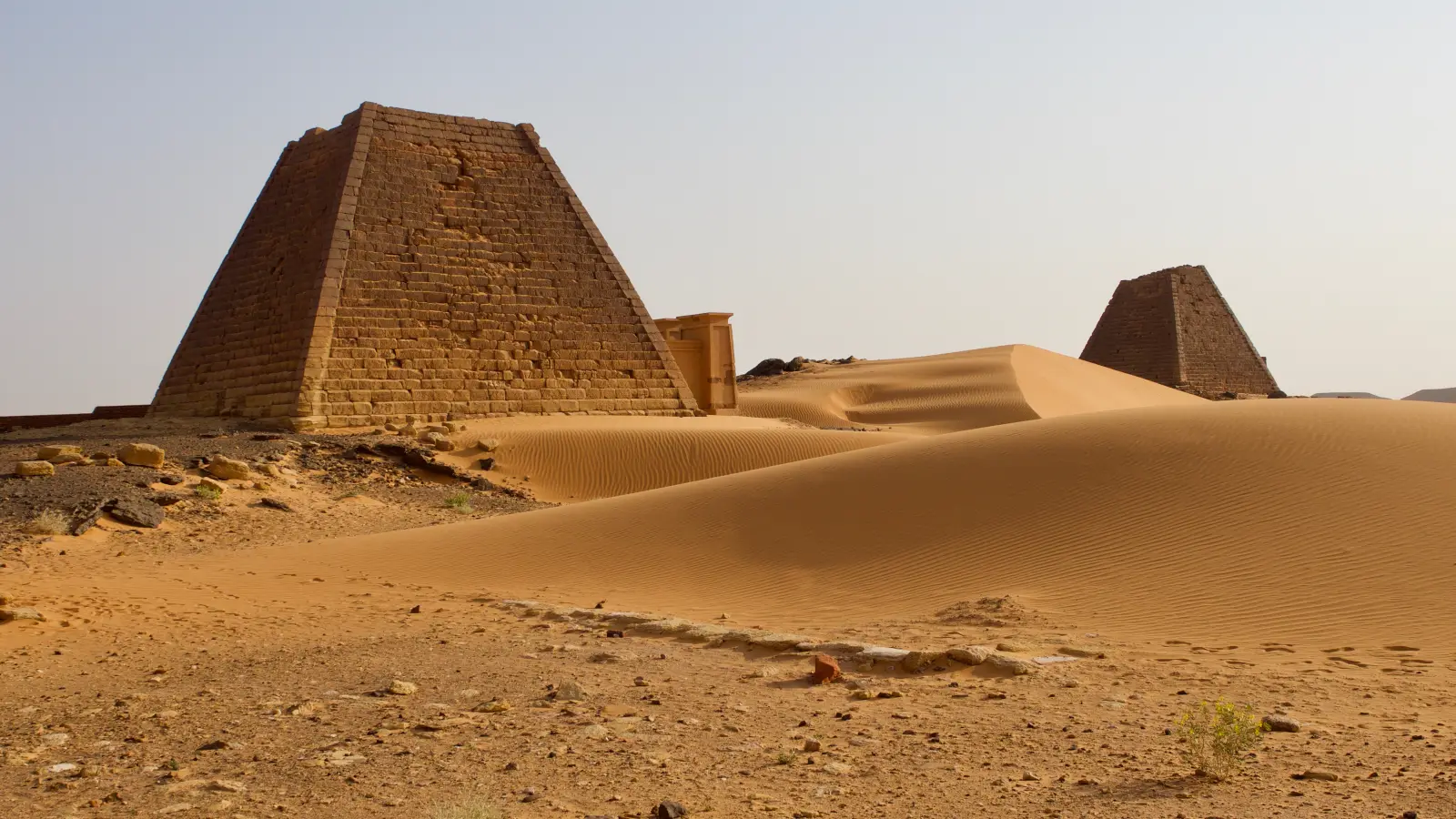
Royal cemeteries of the Kingdom of Kush near Meroë. Roughly 140 pyramidal superstructures stand among more than 1,000 graves.
In the desert east of the Nile, rows of steep-sided pyramids rise from the cemeteries of Meroë. Their shape may recall monuments farther north in Egypt, but they belong to a different political and cultural history. These were royal burials of the Kingdom of Kush, an African state centred in what is now Sudan. For centuries, Kushite rulers governed cities, maintained temples, controlled trade routes, worked iron, and developed their own written language.
Meroë became a principal royal centre of Kush during the first millennium BCE. From around the third century BCE, most Kushite kings and queens were buried in the cemeteries nearby. The surviving pyramids are therefore the most visible part of a much larger landscape that included a capital city, industrial quarters, palaces, temples, reservoirs, settlements, and agricultural land.
Pyramids with Kushite identities
Kush had a long and complicated relationship with Egypt. At times it was invaded from the north; at others, Kushite kings ruled Egypt as its Twenty-fifth Dynasty. Egyptian religious ideas and artistic forms remained influential, but Meroitic builders did not merely reproduce old Egyptian monuments at a reduced scale.
The pyramids at Meroë are generally smaller and much steeper than the great Old Kingdom pyramids. A chapel was built against the eastern side, where offerings and commemorative rituals could take place. The burial chamber itself lay underground, reached by a stairway cut into the ground outside the pyramid. Reliefs in the chapel presented the dead ruler before deities and receiving offerings.
Over time, Egyptian imagery mixed with local customs and elements drawn from the Mediterranean world. Crown forms, clothing, jewellery, royal proportions, and the treatment of figures developed in distinctly Kushite ways. A relief now in the British Museum, originally from the pyramid chapel of Queen Shanakdakhete, shows how inherited Egyptian conventions were adapted within a Meroitic royal setting.
Queens, kings, and a language still being read
Women could exercise striking political authority in Kush. Classical writers used a form of the title kandake when referring to ruling women or queen mothers, although it should not be treated as the personal name "Candace." Royal women appear prominently in Meroitic art, and some ruled in their own right.
Queen Amanirenas is associated with Kush's conflict against Roman forces near the end of the first century BCE. A stela from Hamadab names Amanirenas and the prince Akinidad in Meroitic script and was probably connected with that struggle, but its full message remains uncertain. Scholars can read the signs of Meroitic writing phonetically, yet the language itself is still only partly understood. The names and repeated formulas are clearer than many complete sentences.
That gap matters. Much of Meroë's history has been reconstructed from archaeology, Egyptian and classical accounts, art, and inscriptions that resist full translation. The monuments are eloquent, but they do not answer every question modern visitors bring to them.
A capital of production and exchange
The royal cemeteries can draw attention away from the city. Meroë stood within networks linking central Africa, the Nile Valley, the Red Sea, the Mediterranean, and the Middle East. Excavations have identified palace and temple remains, domestic areas, pottery, and large quantities of iron-working debris. The scale of the slag heaps shows sustained production, though the old nickname "Birmingham of Africa" says more about modern industrial comparisons than about how Kushite production was organised.
Water management was essential in this dry environment. The wider Meroitic landscape includes large reservoirs known as hafirs, especially at centres such as Musawwarat es-Sufra and Naqa. These places, together with Meroë, form the UNESCO property called the Archaeological Sites of the Island of Meroe. The word "island" is historical geography: the region is bounded by rivers, not surrounded by water like an ordinary island.
Trade and exchange did not make Meroë culturally passive. Imported objects and foreign styles were selected, reworked, and placed within a Kushite system of kingship and religion. The resulting culture was connected to its neighbours while remaining recognisably its own.
Damage, reconstruction, and survival
Many pyramids have lost their upper sections. Weather, age, and stone removal played a role, but some destruction was deliberate. In the 1830s, the Italian treasure hunter Giuseppe Ferlini blasted into several pyramids while searching for valuables. His methods caused severe and irreversible damage, even though the jewellery he found helped draw European attention to Meroë.
Later excavations produced plans, objects, and historical information, but they also divided finds among institutions far from Sudan. Conservation today has to address unstable masonry, windblown sand, tourism, development, and the legacy of earlier reconstruction. Some pyramid profiles visible now include restored portions, so the cemetery is both an ancient landscape and a record of modern intervention.
The pyramids remain powerful because they resist an old habit of placing ancient African history in Egypt alone. Meroë was neither an isolated desert outpost nor a faint copy of another civilisation. Its cemeteries belonged to an independent kingdom whose people reshaped ideas from several worlds and left a monumental language of their own.