Easter Island Moai
Around 900 monumental figures carved by Rapa Nui communities, many representing ancestors. Numerous moai once stood on ceremonial ahu and were later toppled; several have since been re-erected.
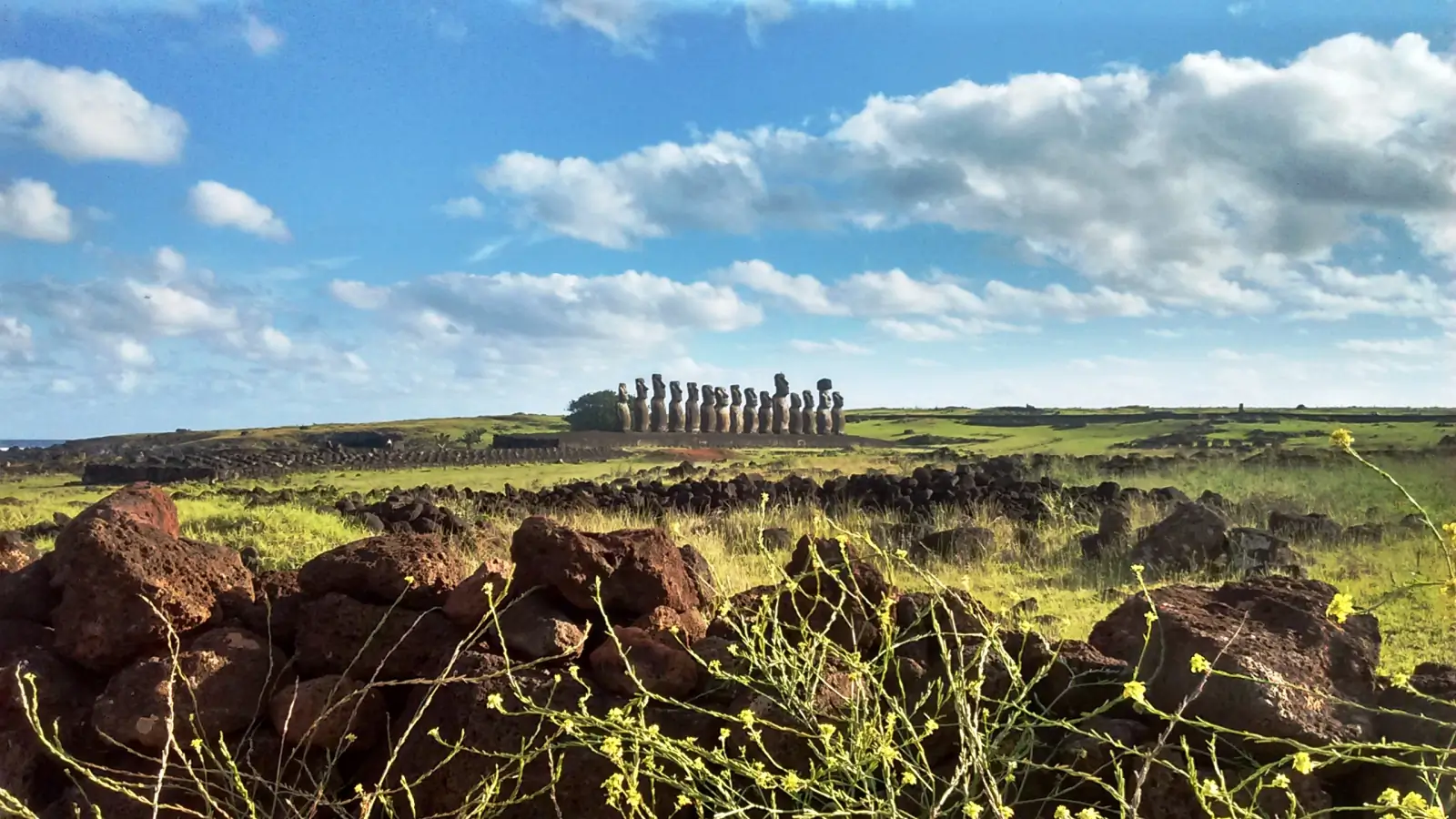
The moai of Rapa Nui are often introduced as a mystery: giant heads standing on an isolated island, their makers reduced to an anonymous vanished people. Almost every part of that image is misleading. The statues have bodies. They were made by Polynesian ancestors of the living Rapa Nui community. Many stood on ceremonial platforms within inhabited landscapes, facing inland toward the people and places to which they belonged.
Rapa Nui is the island's Indigenous name; Easter Island is the better-known international name and remains useful for search and orientation. The monuments make most sense when the island is approached as a living cultural landscape rather than an abandoned stage set in the Pacific.
Ancestors on the ahu
UNESCO records roughly nine hundred moai and more than three hundred ceremonial platforms, or ahu, across Rapa Nui. The figures differ in size, shape, finish, and setting. Some remain in the quarry, some lie along routes, some were toppled, and others have been re-erected through documented restoration projects.
Moai are generally understood as images of important ancestors. Raised on an ahu near a community, a statue linked the living with genealogy, authority, land, and sacred power. This helps explain why many coastal moai look away from the sea. Their attention is directed toward the settlement and the descendants under their care, not toward an approaching ship.
An ahu was more than a stone base. These carefully built platforms could belong to ceremonial and funerary spaces with paved ramps, open areas, burials, and nearby habitation. A row of statues should therefore be read as part of a social place, not as an outdoor sculpture display.
The mountain where statues took shape
Most moai were carved from the compressed volcanic tuff of Rano Raraku. The crater and its outer slopes preserve figures at many stages of production. Outlines were cut into the rock, the body was shaped while still attached, and the statue was separated before being moved down the slope. The quarry is valuable precisely because unfinished work remains visible there.
Some figures appear only as heads because soil accumulated around their torsos. Excavations have documented long bodies below the present ground level, sometimes with carvings on their backs. Others were never deeply buried. There is no single condition shared by every moai.
Red cylindrical additions known as pukao were carved from scoria at Puna Pau and placed on some statues. They are often called hats, though they may represent a hairstyle or topknot. As with the statues themselves, a familiar modern label should not be mistaken for a complete explanation.
How did the moai move?
The largest transported statues weighed many tonnes and had to cross uneven ground between quarry and platform. Rapa Nui oral traditions say that the moai walked. Modern experiments have shown that upright replicas can be moved with ropes by coordinated teams, rocking the figure from side to side and forward. Other transport methods have also been proposed, including movement on wooden supports.
An experiment can demonstrate that a method works; it does not prove that every statue travelled in exactly that way. Roads, fallen figures, quarry evidence, statue shape, oral history, and engineering tests all contribute different pieces. The most interesting conclusion is not a single trick but the organisation behind it. Moving a moai required planning, labour, fibre ropes, food, timing, and agreement about where the ancestor would stand.
Toppling was history, not disappearance
By the time European visitors began leaving written accounts, Rapa Nui society had already experienced profound political and environmental change. Moai were toppled during periods of conflict and social transformation. The sequence was not a simple morality tale in which islanders suddenly destroyed their own culture after using every tree.
Later violence came from outside. Slave raids in the nineteenth century, introduced diseases, forced removals, land seizure, and colonial control devastated the Rapa Nui population and disrupted the transmission of knowledge. Those events are essential to the history of the monuments. They cannot be replaced by a neat story of self-inflicted collapse.
The culture did not end when statues fell. Ceremonial practices changed, communities endured, and the monuments remained part of Rapa Nui memory. Some restored ahu now show upright figures again, but restoration is itself a modern chapter and is documented as such.
A living landscape under Rapa Nui care
Rapa Nui National Park protects about forty percent of the island and includes quarries, ahu, moai, village remains, agricultural features, petroglyphs, and ceremonial sites. Since 2017 the park has been managed by the Ma'u Henua Indigenous Community. That stewardship matters: the descendants of the people who created the monuments are responsible for decisions about access, conservation, and respectful interpretation.
Weathering, wildfire, invasive vegetation, animals, sea-level change, and tourism all threaten fragile volcanic stone. Visitors encounter powerful monuments, but they are not ownerless ruins. They stand within ancestral land that continues to carry names, stories, obligations, and community life.
The moai do not become less impressive when the mystery label is removed. They become more human. Each figure belongs to a chain of choices made by carvers, organisers, families, and descendants who transformed volcanic rock into an ancestor with a place in the landscape.