Monte Albán
Zapotec capital, levelled atop a flattened mountaintop. The Danzantes carvings depict mutilated captives.
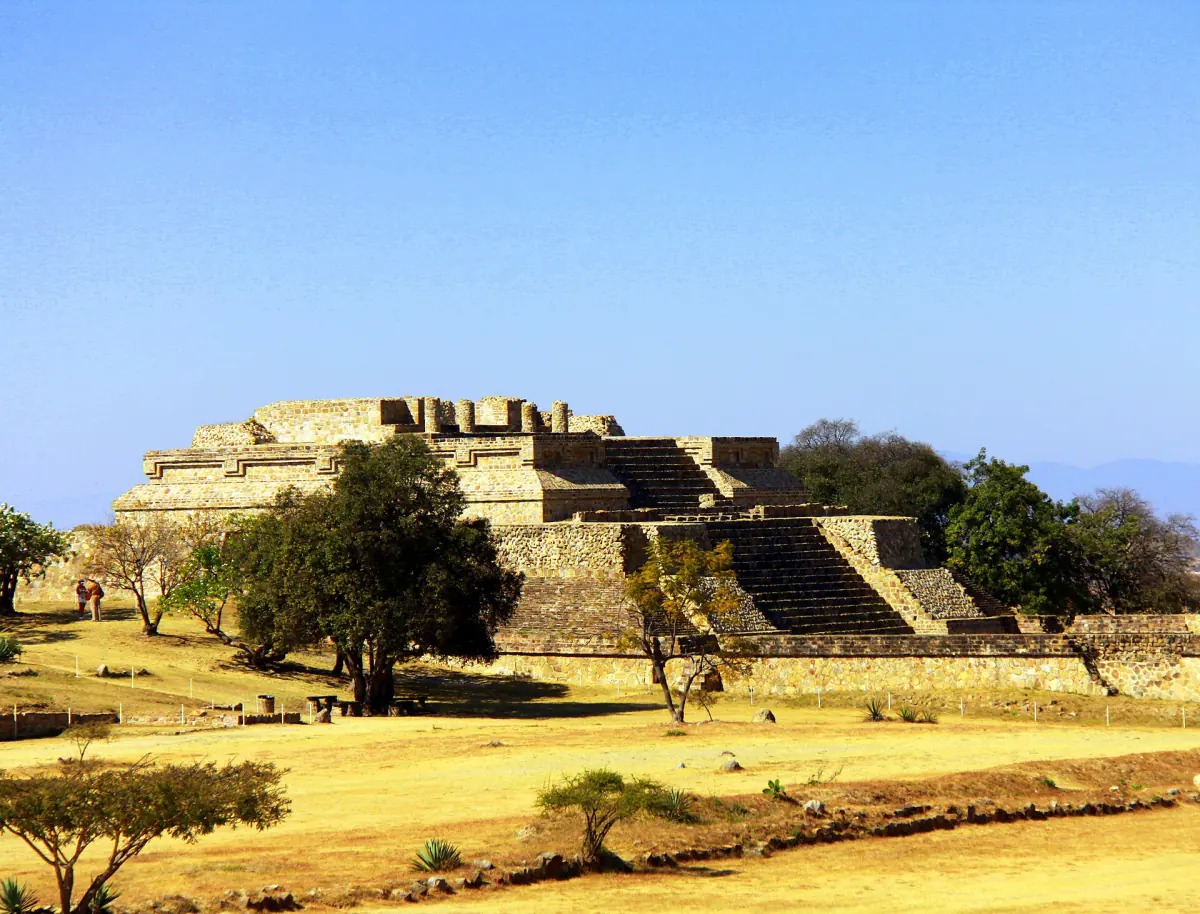
Monte Albán occupies a mountain summit where no natural plateau of its scale once existed. Beginning around 500 BCE, builders cut, filled, terraced, and levelled the high ground above the Valley of Oaxaca. The result was a capital visible across several branches of the valley, with a great central plaza, temples, palaces, tombs, ballcourts, and carved monuments.
The people who founded the city are generally identified with the ancestors of the Zapotecs. Their descendants still live throughout Oaxaca, and Zapotec languages remain part of the region's cultural life. Monte Albán belongs to that continuing history, even though its ancient name is uncertain. Suggestions such as Danibaan, "Sacred Mountain," are possible reconstructions rather than securely recorded names.
Making a capital on a mountain
The location was difficult by design. Water, food, stone, and everyday goods had to be moved uphill. The summit was less convenient for farming than the valley floor, but it commanded a wide view and created a powerful shared centre among communities that had previously been more dispersed.
The Main Plaza extends roughly 300 metres from north to south. Platforms close its ends, while temples and other buildings define its sides. The carefully balanced arrangement was not laid out all at once. Structures were enlarged, covered, rebuilt, and reoriented over centuries. Beneath the visible plaza are earlier stages of the city.
At its height, Monte Albán may have held around 35,000 people across the summit, terraces, and neighbouring hills. Most inhabitants did not live among the monumental buildings. Houses occupied terraces cut into the slopes, where families cooked, made tools, stored food, and buried relatives beneath domestic floors and patios. The ceremonial centre was the most visible part of a much larger city.
The figures called Danzantes
Among Monte Albán's earliest monuments are carved stone slabs traditionally called Los Danzantes, or the Dancers. The name came from the twisted poses of the naked figures. They are now more often interpreted as captives, defeated leaders, sacrificial victims, or dead enemies. Some show signs that may indicate wounds or bodily mutilation.
Their precise meaning remains debated, but the carvings are closely tied to political power. They were displayed in large groups, turning human bodies into a public statement about victory and authority. Several slabs also contain early signs related to Zapotec writing. Monte Albán preserves one of Mesoamerica's earliest substantial records of writing and calendrical notation.
A later building in the centre of the plaza, known simply as Building J, has an unusual arrow-like plan. Carved slabs on its walls name places, sometimes alongside inverted heads and other signs interpreted as records of conquest. The structure is often described as an astronomical observatory because it differs from the plaza's main alignment. Some orientations may have celestial significance, but its inscribed political programme is clearer than any single observatory function.
Relations beyond the Oaxaca Valley
Monte Albán was not isolated on its mountain. Ceramics, imagery, writing, and foreign objects show contact across Mesoamerica. Relations with Teotihuacan in central Mexico became especially important between about 200 and 500 CE. A neighbourhood in Teotihuacan was occupied by people connected with Oaxaca, while objects and architectural ideas moved in both directions.
Those connections could involve merchants, diplomats, craftspeople, marriages, and political competition. They should not be reduced to a simple story in which one city conquered the other. The evidence reveals sustained interaction, but the balance of power probably changed through time.
Monte Albán also influenced communities throughout Oaxaca. Outlying centres and hilltop complexes formed part of a regional political landscape. Dams, terraces, and canals altered the mountain and helped manage water in an environment where a large population required careful organisation.
Tombs and the city's later life
Zapotec tombs were often built beneath houses and elite residences. Painted walls, carved doorjambs, ceramic vessels, and urn-like figures connected the dead with ancestors and supernatural powers. Many tombs were reopened for later burials, showing that they were places of repeated family memory rather than sealed time capsules.
Monte Albán's political importance declined after about 800 CE for reasons that remain uncertain. Population shifted toward other centres, and the great plaza was used less intensively. The mountain was not forgotten. Mixtec communities later revisited and reused older tombs.
The most famous example is Tomb 7, an earlier Zapotec structure that contained a later Mixtec offering of gold, turquoise, crystal, shell, bone, and other finely worked materials. Alfonso Caso excavated it in 1932. The discovery became central to Mexican archaeology, but the spectacular objects can obscure the more important point: later people recognised the ancient capital as a meaningful place and inserted their own histories into it.
Monte Albán's long occupation cannot be assigned to a single unchanging culture. Zapotec foundations, changing regional relationships, Mixtec reuse, and modern archaeological intervention all belong to the site. Its summit architecture still looks detached from ordinary terrain, yet the city was always connected to the communities, fields, routes, and languages of the Oaxaca Valley below.