Mount Nemrut
Funerary sanctuary of King Antiochus I of Commagene, centred on a great summit tumulus and terraces lined with colossal figures of gods and royal ancestors.
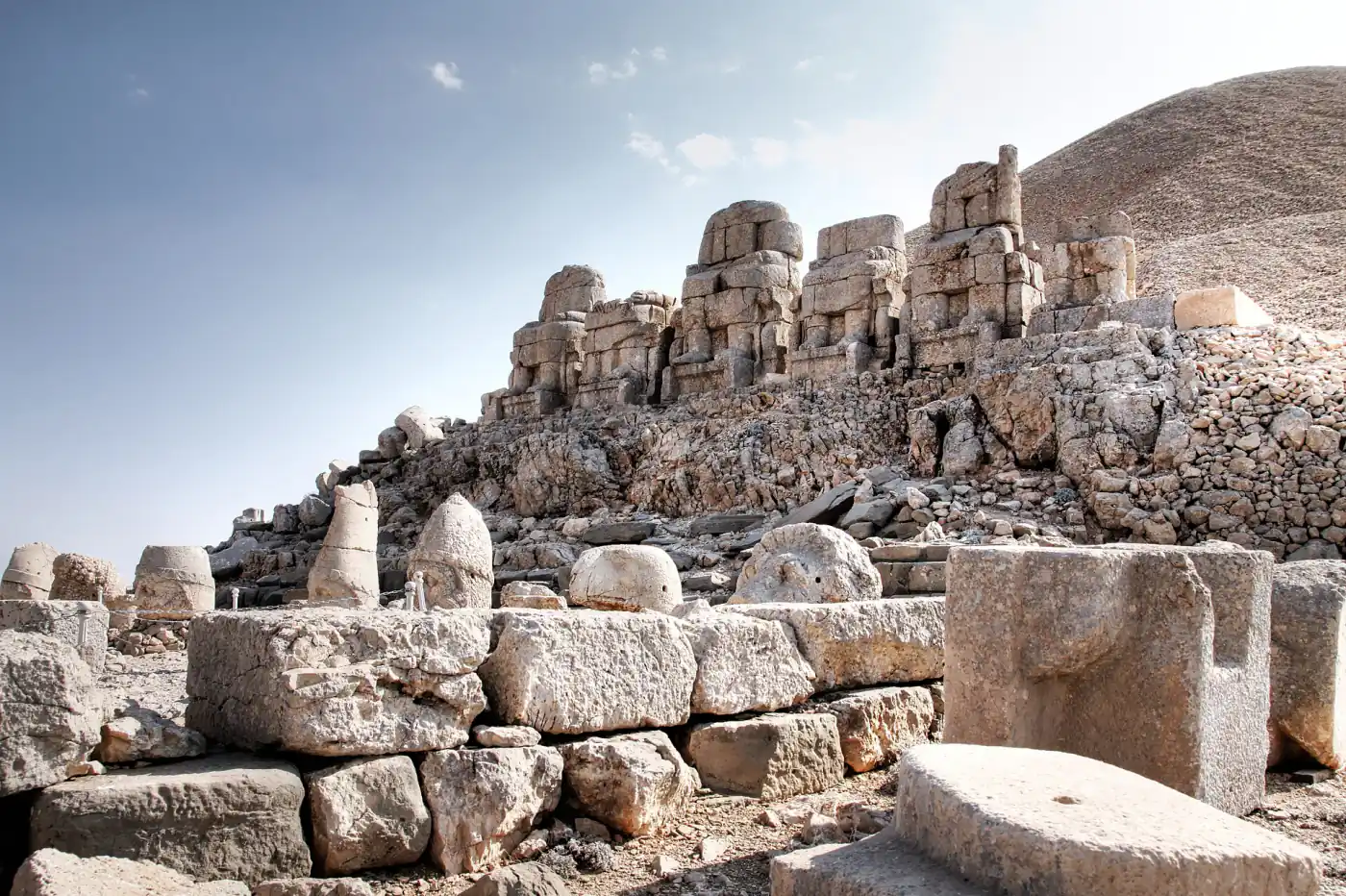
At sunrise and sunset, the stone heads on Mount Nemrut appear to watch the horizon from ground level. They once belonged to seated figures up to ten metres high. Their bodies still face outward from terraces around a mound of crushed limestone, while the detached heads rest below them among altars and reliefs.
The broken arrangement looks like the aftermath of a deliberate destruction. Weather, earthquakes and the failure of joints offer a less dramatic explanation for much of what happened. UNESCO records severe daily and seasonal temperature changes, freezing, thawing, wind, snow and seismic risk. Centuries on an exposed summit can dismantle a monument without a single iconoclast.
The sanctuary was created for Antiochus I, who ruled the kingdom of Commagene from 69 to 34 BCE. He called it a hierothesion, a temple-tomb and house of the gods. It was a place for royal burial, public ceremony and a carefully constructed account of who Antiochus believed himself to be.
A kingdom between great powers
Commagene occupied territory north of Syria and the Euphrates in the aftermath of Alexander the Great’s empire. By Antiochus’s time, the kingdom stood between Roman expansion to the west and Parthian power to the east. Its court drew on Greek, Persian and local Anatolian traditions.
Antiochus turned that position into a political language. In inscriptions and reliefs, he claimed descent from the Persian king Darius through his father’s line and from Alexander through his mother. These genealogies were partly legendary. Their purpose was not modern family history. They placed a small dynasty within two prestigious imperial pasts.
The gods received the same treatment. Zeus was joined with Oromasdes, the Iranian Ahuramazda. Heracles was combined with Artagnes, related to the Iranian Verethragna. Apollo, Mithras, Helios and Hermes appeared together in another composite identity. Greek and Persian traditions shared bodies and names in a pantheon fashioned for Antiochus’s kingdom.
This mixture is sometimes described as indecision between East and West. At Mount Nemrut it looks deliberate. Antiochus presented Commagene as a centre capable of containing both, with the king acting as their divinely favoured mediator.
Building a new summit
The monument crowns a peak about 2,150 metres above sea level in the Eastern Taurus. Its central tumulus is a mound of small limestone fragments roughly 145 to 150 metres across and about 50 metres high today. UNESCO estimates that weathering and earlier investigations reduced an original height of around 60 metres.
Terraces lie to the east, west and north. The east and west terraces each held a row of five colossal seated figures flanked by guardian eagles and lions. Inscriptions identify the deities and the king. Sandstone reliefs showed Antiochus’s Persian and Macedonian ancestors, turning lineage into a processional display.
The east terrace appears to have been the principal setting for large ceremonies. It includes a raised altar platform and a formal court beneath the statues. The west terrace holds a group of dexiosis reliefs in which Antiochus clasps hands with individual gods. The gesture places him close to the divine without making the scene an ordinary meeting between equals.
The northern terrace is narrower and less complete. A line of pedestals may have bordered a processional route between the eastern and western courts. Because the associated stelae lack reliefs and inscriptions, its final intended arrangement remains uncertain.
Some blocks weigh as much as nine tonnes. Quarrying and assembling them at the summit required skilled planning, yet the tumulus itself posed a different problem. Loose stone fragments slide back into any opening dug through them. That behaviour may have helped protect the burial chamber and continues to frustrate attempts to locate it.
The tomb no one has reached
Inscriptions state that Antiochus’s burial belonged at the sanctuary. Archaeologists have studied the summit since the monument was documented in the nineteenth century, but no burial chamber has been discovered. The Turkish Ministry of Culture notes that the king’s bones or ashes are thought to have been placed in a chamber cut into the bedrock and then covered by the artificial mound.
That reconstruction is plausible rather than confirmed. The chamber could lie elsewhere within the monument, and its contents may not survive. Calling Nemrut “the tomb of Antiochus” describes the intended function recorded in the ancient programme; it does not mean excavators have opened a room containing his remains.
The missing chamber has encouraged treasure stories and dramatic scanning claims. It also creates a serious conservation problem. Aggressive tunnelling could destabilise the tumulus, displace ancient surfaces and still fail to find the burial. At Nemrut, leaving a question unanswered may protect more evidence than forcing an answer.
A calendar written by the king
Antiochus set out rules for his cult in long Greek inscriptions. They prescribed celebrations of his birthday and accession, offerings, music and shared meals. Priests were appointed and communities were instructed to gather at the sanctuary. The texts make Mount Nemrut unusually explicit compared with monuments whose ceremonies must be reconstructed only from architecture.
One west-terrace relief shows a lion with stars and a crescent on its body. It is often called the Lion Horoscope. Scholars have proposed dates based on the astronomical arrangement, including a date in 62 or 61 BCE, but the exact event represented remains debated. The relief confirms Antiochus’s interest in linking royal time with the heavens; it should not be treated as a perfectly solved timestamp.
The inscriptions and images repeat the same ambition. Antiochus wanted regular ceremonies to continue after his death, with the king remembered among the gods and ancestors. Whether that cult endured for centuries is harder to establish than the programme he ordered.
Preserving a monument in extreme weather
Mount Nemrut is protected as both an archaeological site and part of a national park. Conservation teams face cracked limestone, eroding sandstone, unstable fragments, snow, wind and earthquakes near the East Anatolian Fault. Past attempts to investigate or rearrange the site also changed the mound and terraces.
The Commagene Nemrut Conservation Development Programme, led by Turkey’s Ministry of Culture and Tourism with Middle East Technical University, documented the monument, studied stone decay and structural risk, and developed proposals for consolidation and preventive care. The goal is not to rebuild a flawless row of statues. Reassembly can introduce new stress and erase evidence of how the monument changed.
The fallen heads have become the modern image of Nemrut, but the site was conceived as a whole landscape: processional roads, terraces, ancestors, gods, inscriptions, altar and hidden burial. What makes Nemrut compelling is the political imagination of a king who placed a small kingdom on a mountain and made it speak in several cultural languages at once.