
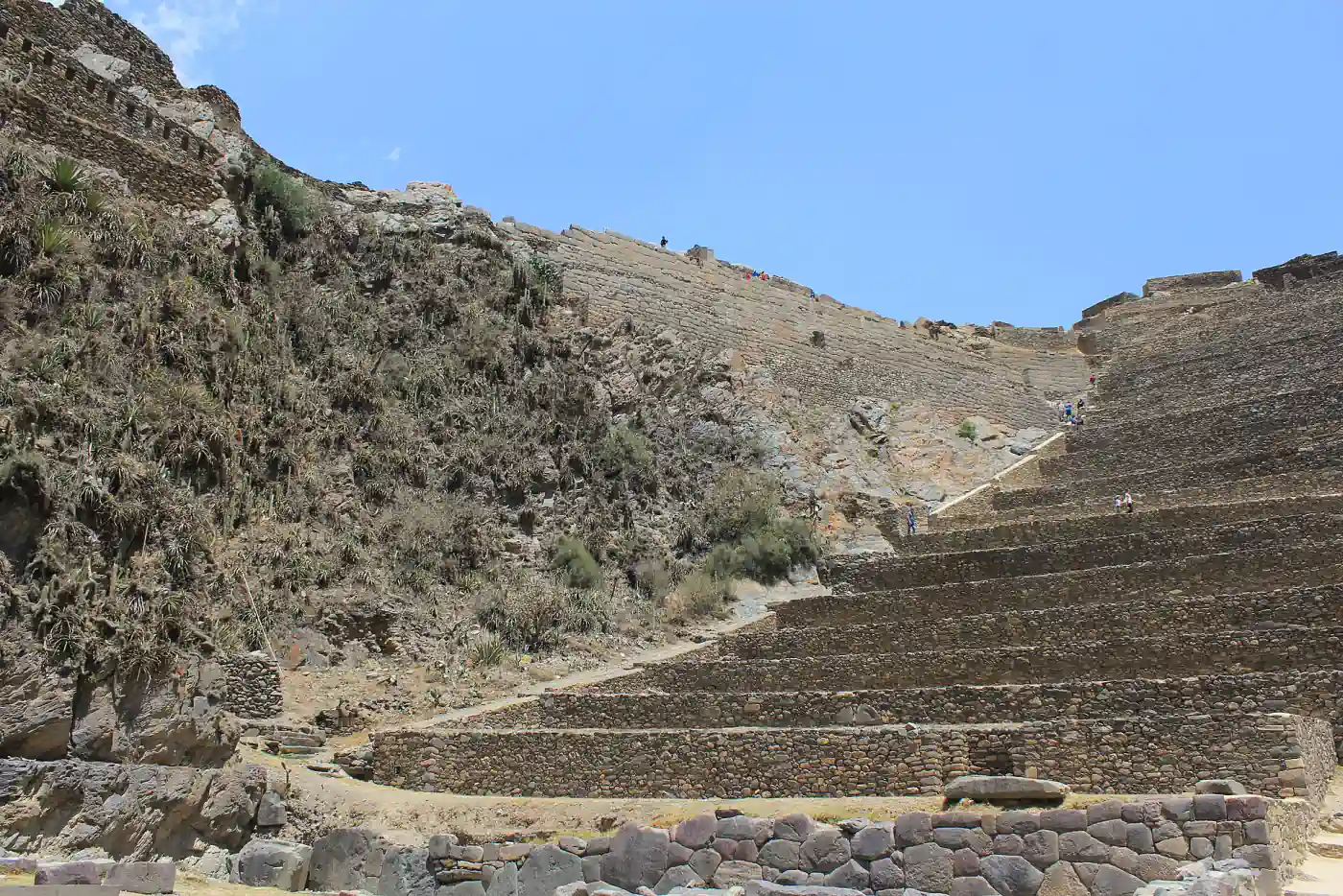
Ollantaytambo
Royal Inca estate of Pachacuti, then last stronghold of Manco Inca's resistance. Six pink granite monoliths weighing 50 tonnes each remain unfinished on Temple Hill.
Water runs beside the streets of Ollantaytambo through channels laid out before the Spanish conquest. Stone doorways open into residential compounds, and narrow lanes follow a planned pattern between the Patakancha River and the steep valley walls. Above the roofs, terraces climb toward an unfinished ceremonial complex built from blocks carried across the Urubamba valley.
Calling Ollantaytambo a ruin misses the most unusual part of it. The archaeological remains stand within and around an inhabited Andean town. Families use spaces shaped by Inca planners, even as modern building, tourism and traffic place new pressure on the old fabric. Ancient architecture here is neither sealed away nor frozen at a single date.
The site also served several purposes. It was a royal estate, administrative centre, agricultural landscape, religious place, storage hub and strategic gateway toward the eastern forests. Its later reputation as a fortress comes from a real battle, but walls and terraces alone cannot explain the settlement.
A planned centre in the Sacred Valley
The Cusco Directorate of Culture describes Ollantaytambo as a planned Inca town divided into two main sectors, Qosqo Ayllu and Araccama Ayllu. Plazas, halls, elite residences and shrines were integrated with terraces, storehouses, platforms and enclosing walls. Its position near the confluence of the Patakancha and Urubamba rivers made it a natural point of movement through the Sacred Valley and toward routes leading into the forested east.
Sixteenth-century chroniclers did not agree completely about who founded the imperial complex. Pedro Sarmiento de Gamboa associated it with Pachacuti, the ruler credited with a major expansion of the Inca state. Garcilaso de la Vega offered a different attribution to Viracocha Inca. Archaeology supports extensive imperial rebuilding in the fifteenth century, but the disagreement is a reminder that later written accounts are evidence to be compared, not transcripts of the past.
Earlier communities had already occupied the valley. Inca planners reorganised this inherited landscape on a royal scale. Agricultural terraces widened usable ground, controlled erosion and displayed command over water and labour. Storehouses on the slopes took advantage of ventilation. Roads connected the settlement with Cusco, nearby estates and the broader Inca network.
The residential core is one of Ollantaytambo’s most informative features. Blocks of one-room buildings open onto shared courtyards through narrow entrance passages. Water channels run along the lanes and into compounds. The pattern shows planning at the level of ordinary movement: how a person entered a neighbourhood, crossed a threshold, reached water or shared space with related households.
The unfinished work on Temple Hill
The steep terraces west of the town are often labelled a fortress. Their height made them defensible, but the finely worked masonry at the summit points to a major ceremonial project. The best-known remains are six enormous upright blocks of reddish stone, separated by narrower fitted pieces. They are usually called the Wall of the Six Monoliths.
The wall was left incomplete. Nearby blocks bear unfinished surfaces, bosses and cuttings connected with transport and fitting. The evidence is valuable because it exposes construction as a process. Ollantaytambo does not show only a polished final product; it preserves stages at which stone was selected, moved, adjusted and sometimes abandoned.
Much of the temple stone came from quarries at Kachiqhata across the Urubamba River. Moving it required a descent from the quarry, a river crossing and an ascent to Temple Hill. Surviving quarry areas, roads and blocks left along the route allow archaeologists to study that journey. Experiments and tool marks show what coordinated labour, ropes, levers, prepared ramps and patient adjustment could achieve. There is no need to turn unfinished masonry into evidence of an unknown civilisation.
Water shaped the sacred zone as deliberately as stone. Channels, fountains and carved surfaces directed a controlled flow through the complex. Their precise ritual meanings are not recorded. They do show that Inca designers understood the valley as a linked system in which springs, rivers, cultivated slopes and ceremonial architecture belonged together.
The battle Manco Inca won
Ollantaytambo became a centre of resistance after the Spanish seizure of Cusco. In 1536, Manco Inca established himself here and faced an expedition led by Hernando Pizarro. The slopes and terraces gave Inca defenders high positions from which to attack. Accounts also describe water being released across the plain, hindering Spanish horses and forcing the expedition to withdraw.
It was a significant Inca victory, though it did not reverse the conquest. Manco Inca later left Ollantaytambo for the more remote Vilcabamba region. The departure ended the site’s brief role as his principal stronghold, while occupation of the town continued under colonial rule.
This episode explains why the word “fortress” became attached so firmly to Ollantaytambo. It should not be allowed to swallow the rest of the evidence. The settlement was already a royal, economic and ceremonial centre before Manco Inca fortified it. A place built to organise a valley became defensible because of where and how it had been built.
A living town under pressure
Ollantaytambo is sometimes promoted as a “living Inca town.” The phrase is useful when it points to continuity in streets, canals, farming, language and community life. It becomes misleading if it suggests that residents have remained unchanged since the fifteenth century. The town has passed through conquest, colonial resettlement, new religions, rail travel, tourism and modern municipal growth.
That continuity makes conservation difficult. A roof, doorway or drainage pipe can be part of someone’s home while also affecting protected archaeological fabric. In 2025, Peru’s Ministry of Culture began proceedings over an unauthorised three-storey construction inside the archaeological park. The case was not an abstract dispute about appearance. Officials argued that incompatible materials and scale harmed the integrity of the historic urban setting.
Protecting Ollantaytambo therefore cannot mean emptying it of residents. It requires careful rules, local participation and practical ways to maintain homes without dismantling the evidence embedded in them. The old channels must still carry water. Streets must still function. Archaeological walls must survive daily contact.
The result is a place where the past is unusually close but never simple. An Inca doorway may frame a modern household. A ceremonial terrace may also recall a battle. An unfinished stone may answer one question about construction while leaving another open. Ollantaytambo remains legible because people kept living there, and vulnerable for exactly the same reason.