Palmyra
Caravan oasis between Rome and Persia. Significant portions destroyed in 2015–2017; partial restoration is ongoing.
Palmyra grew around an oasis between the Mediterranean coast and the Euphrates. To its inhabitants it was Tadmor, an old Semitic name recorded long before Rome controlled Syria. Under Roman rule, the city became wealthy through caravan trade and filled its landscape with temples, colonnaded streets, public buildings, and elaborate tombs.
Its architecture is often labelled Roman because columns, pediments, theatres, and civic spaces look familiar from the Mediterranean world. That description is incomplete. Palmyrene builders combined Graeco-Roman forms with local religious traditions and influences from Parthian and Persian lands to the east. The result expressed a city that belonged to several worlds without dissolving into any one of them.
Trade required organisation
Palmyra did not become rich merely because caravans happened to pass its oasis. Merchants financed expeditions, negotiated protection, organised animals and supplies, maintained partnerships abroad, and paid taxes and fees. Inscriptions honour people who led caravans safely across dangerous distances.
Goods moving through these networks included textiles, spices, aromatics, precious stones, glass, wine, and other high-value cargo. Palmyrene traders operated along the Euphrates and connected with routes extending toward the Persian Gulf and Indian Ocean. Inscriptions naming Palmyrenes have been found far from Syria, including Mesopotamia and Roman Britain.
A tariff inscription erected in 137 CE listed charges on goods and services entering or leaving the city. The document is practical evidence of local government regulating commerce. Palmyra was connected to Roman imperial power, but its council, merchants, priests, and prominent families managed much of urban life.
A city speaking more than one language
Public inscriptions commonly used Palmyrene Aramaic and Greek. Latin appeared less often. Bilingual texts allowed the city to communicate within the eastern Roman world while preserving local names and institutions. A citizen might hold a Roman title, wear clothing associated with Parthian elites, dedicate an altar to a local god, and commission a Greek inscription without seeing those choices as contradictory.
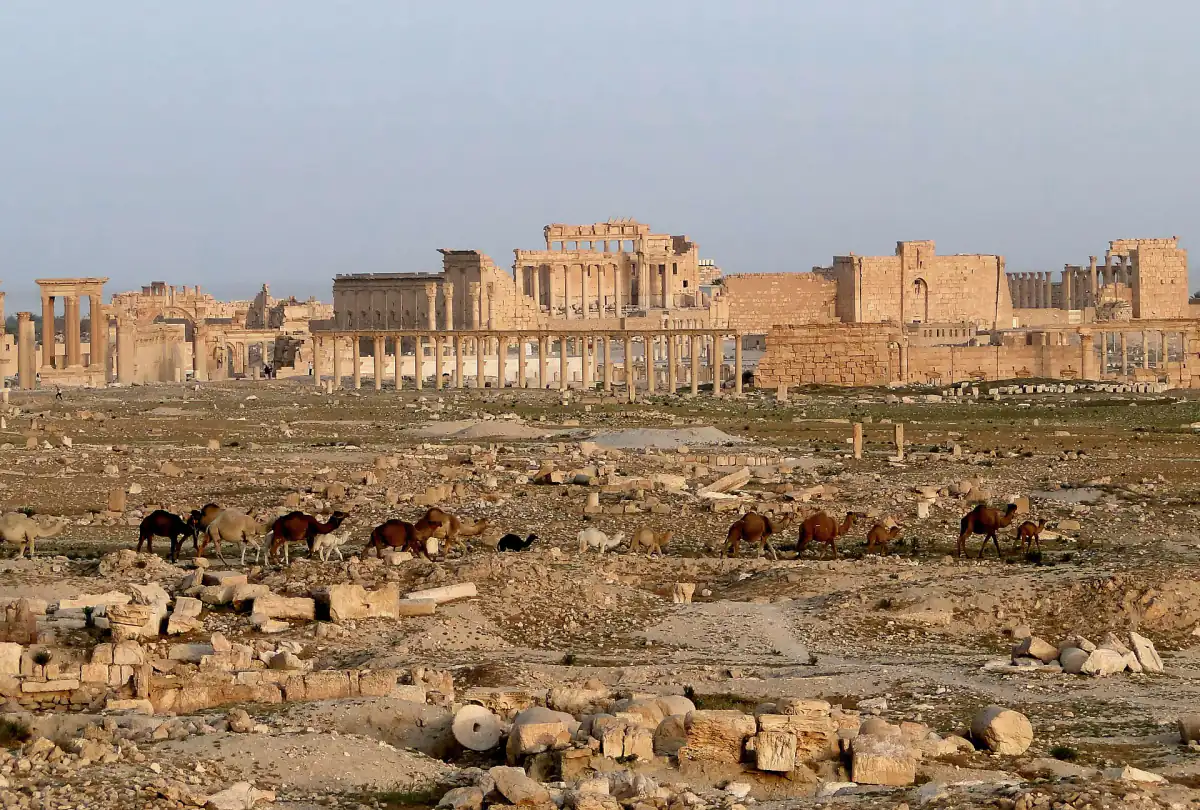
The long colonnaded avenue gave monumental order to the city, but it was not one perfectly straight street built at a single moment. Sections changed alignment and were joined through architectural devices such as the monumental arch. Columns carried projecting brackets that once supported statues honouring benefactors. The empty brackets visible in old photographs were part of a crowded civic display.
The Temple of Bel joined a Near Eastern sacred precinct with classical architectural details. Other sanctuaries honoured Baalshamin, Allat, Nabu, and additional deities. Religious life changed across time, and the city's population eventually included Christian communities. Palmyra's monumental centre was never culturally uniform.
Faces from the tombs
Outside the urban centre, families built tower tombs and underground burial chambers. The dead were placed in stacked niches sealed by limestone reliefs. Many show the deceased facing outward, dressed in carefully rendered clothing and jewellery. Short inscriptions identify names and family relationships, often ending with an expression of grief.
These portraits are stylised rather than modern attempts at exact likeness, yet their details reveal how Palmyrene families presented themselves. Women's reliefs display textiles, headdresses, keys, spindles, and jewellery. Men's portraits may include writing tablets, scrolls, or merchant dress. Traces of paint and gold remind us that the pale stone visible today once carried strong colour.
Thousands of these sculptures were removed to collections around the world. They preserve personal names and social connections, but their dispersal also separates them from the tombs and family groups that gave them meaning.
Odaenathus, Zenobia, and Rome
During the third century, the Roman and Sasanian empires struggled for control of the region. The Palmyrene leader Odaenathus supported Rome and campaigned successfully against Sasanian forces. After his murder in 267 CE, his widow Zenobia ruled as regent for their son Vaballathus.
Zenobia extended Palmyrene control over Egypt and much of Asia Minor. Coins and official titles show an increasingly independent court, although the break with Rome developed over time. Emperor Aurelian defeated Palmyrene forces in 272 and captured Zenobia. A later revolt brought further destruction to the city in 273.
The story has often turned Zenobia into either a romantic rebel queen or a brief footnote to Roman history. From Palmyra's perspective, her rule emerged from decades in which local leaders managed imperial frontiers, defended trade routes, and built power between rival states.
Destruction did not begin in modern news footage
Palmyra had already endured ancient warfare, earthquakes, quarrying, excavation, tourism, and earlier restoration before the Syrian conflict reached it. The site was placed on UNESCO's List of World Heritage in Danger in 2013. Armed groups then caused deliberate and widely documented destruction. The temples of Bel and Baalshamin, the Monumental Arch, and several tower tombs were among the structures blown up in 2015. The museum was damaged and objects were looted or destroyed.
Reconstruction cannot mean rebuilding a picturesque Roman city as though nothing happened. Archaeologists and conservators must identify original fragments, document damage, stabilise what remains, consult Syrian professionals and communities, and decide where reassembly is supported by evidence. The destruction itself has become part of the site's history, however painful.
Palmyra preserves the achievements of a Syrian city that negotiated commerce, identity, religion, and power across imperial boundaries. Its future should be guided by that complex history rather than by a desire for a simplified classical backdrop.