
Parthenon
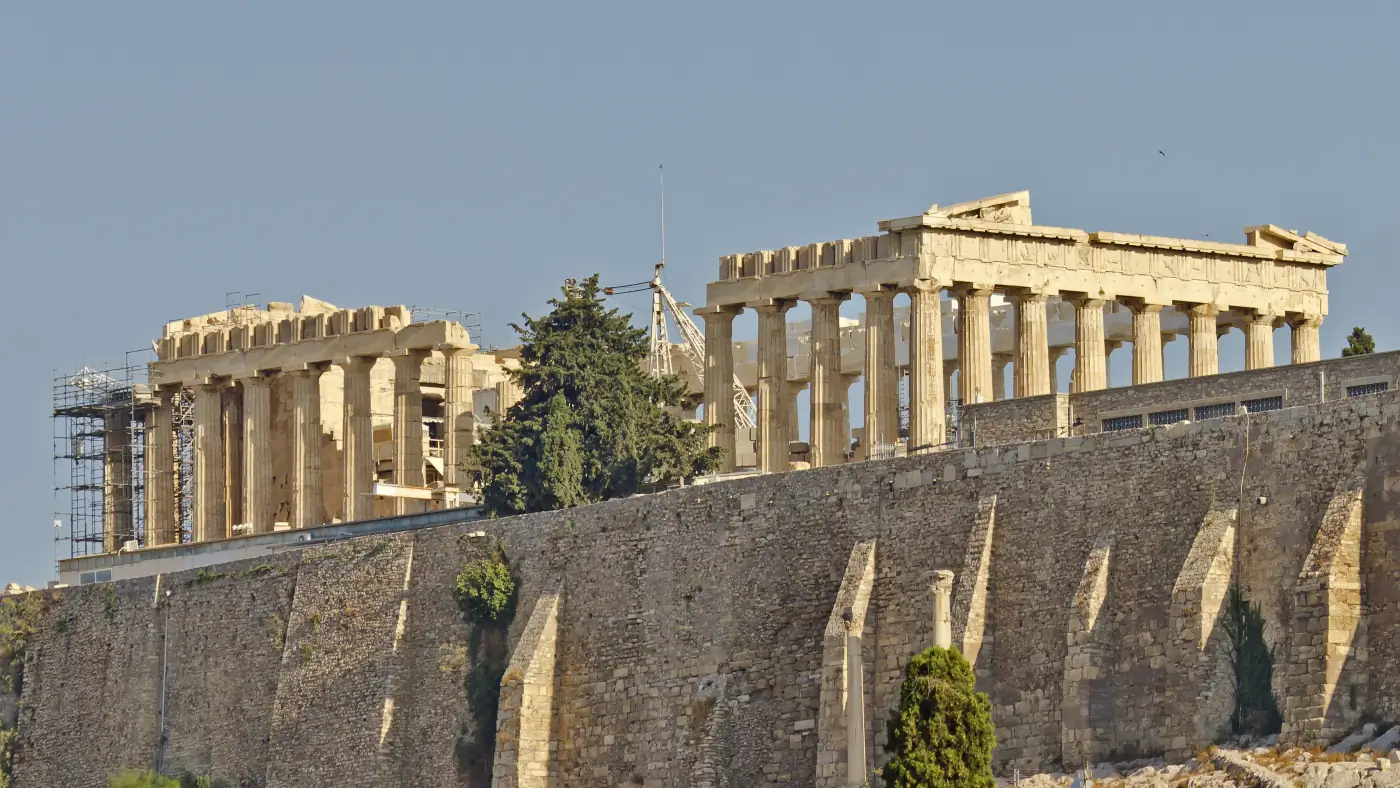
Temple of Athena Parthenos atop the Acropolis. Damaged by Venetian artillery in 1687 when it served as an Ottoman gunpowder store.
The Parthenon stands on the Acropolis of Athens, but it was never an isolated building. It belonged to a sacred hill filled with temples, entrances, statues, shrines, and memories of earlier settlements. The temple was dedicated to Athena Parthenos, the patron goddess of the city, and built during the ambitious Athenian programme of the fifth century BCE.
Construction began in 447 BCE and the main building was completed around 432 BCE. The architects Ictinus and Callicrates worked with the sculptor Pheidias and many other artists, quarry workers, builders, painters, and metalworkers. The surviving marble structure is only part of the monument they created.
A temple after war
The Parthenon replaced an earlier temple destroyed during the Persian sack of Athens in 480 BCE. The new building rose after Athens had defeated the Persians and grown into the leading power of the Delian League. Its construction was religious, civic, and political at the same time.
The temple's cost and the movement of tribute from allied communities were controversial even in antiquity. The building proclaimed devotion to Athena, but it also made Athenian power visible to citizens, visitors, and rival states. The Acropolis became a statement about what the city believed it had achieved.
The Parthenon was a peripteral temple with columns surrounding the central rooms. Its outer colonnade followed the Doric order, while some interior elements used Ionic forms. The combination was deliberate. It created a building that followed familiar Greek conventions but used them with unusual precision.
The sculpture of the temple
The pediments showed scenes from the life and mythology of Athena. The east pediment represented her birth, while the west pediment showed her contest with Poseidon for control of Attica. Metopes around the exterior depicted mythic conflicts, and the long frieze represented a procession associated with the city.
The sculptures were not all pale white marble. Surviving traces and comparisons with ancient practice indicate that colour, metal attachments, and other details once enlivened the surfaces. The modern image of the Parthenon as bare stone is a result of weathering, damage, cleaning, and changing taste.
Inside stood the colossal chryselephantine statue of Athena made by Pheidias. It was constructed from a wooden core with gold and ivory elements and has not survived. The temple's empty interior can therefore give a false impression of the original experience. The most important image in the building is gone.
Precision in the stone
The Parthenon looks regular, but its builders adjusted many elements rather than relying on perfectly straight lines. The platform curves slightly, columns have subtle changes in profile, and corner columns differ from those in the middle of the sides. These refinements helped the building appear balanced when viewed from the ground.
The work required careful planning. Marble blocks were quarried on Mount Pentelicus, moved to the Acropolis, shaped, and lifted into place. The sculptural programme demanded separate teams working across the building. A monument that looks unified from a distance was the product of many specialised tasks.
The building also functioned as a treasury. Gold associated with Athena's statue could be removed or accounted for, and the temple formed part of the financial and religious institutions of the city. It was a financial and religious institution as well as a setting for sculpture.
Church, mosque, and explosion
The Parthenon remained in use for centuries, but its role changed. It became a Christian church dedicated to the Virgin Mary, and after the Ottoman conquest it was used as a mosque. The building's religious identity shifted while its architectural form remained recognisable.
In 1687, during a Venetian attack on Ottoman Athens, gunpowder stored inside the temple exploded. The blast destroyed much of the central structure and scattered the sculptures. The damage was not the result of ancient neglect. It was a consequence of the building being drawn into a modern military conflict.
Later removals, sales, and dispersal of sculptures changed the monument again. The surviving fragments are held in Athens and other collections. Their distribution remains part of the modern history of the Parthenon and of continuing debates over cultural heritage.
Delphi shows another major Greek sanctuary where architecture was shaped by ritual and political competition. Mycenae belongs to the Bronze Age world remembered by later Greeks. Pantheon and Baalbek demonstrate how Roman builders and provincial communities adapted, surpassed, or reinterpreted Greek architectural traditions.
A monument larger than its ruins
The Parthenon is often used as a shorthand for classical Greece, democracy, or Western art. Those associations are powerful, but they can flatten the actual building. The temple was created by a particular city at a particular moment, funded through a contested alliance, and dedicated to a goddess whose cult was embedded in Athenian politics.
Its later history matters just as much. The church, mosque, explosion, restorations, pollution, and debates over displaced sculpture all changed the meaning of the monument. The ruins are not a perfect surviving example of a fifth-century temple. They are the remains of a building that has been used, damaged, admired, and argued over for more than two thousand years.