
Plain of Jars
Thousands of carved stone jars scattered across a high plateau. Heavily contaminated with unexploded ordnance from the Vietnam-era bombing.
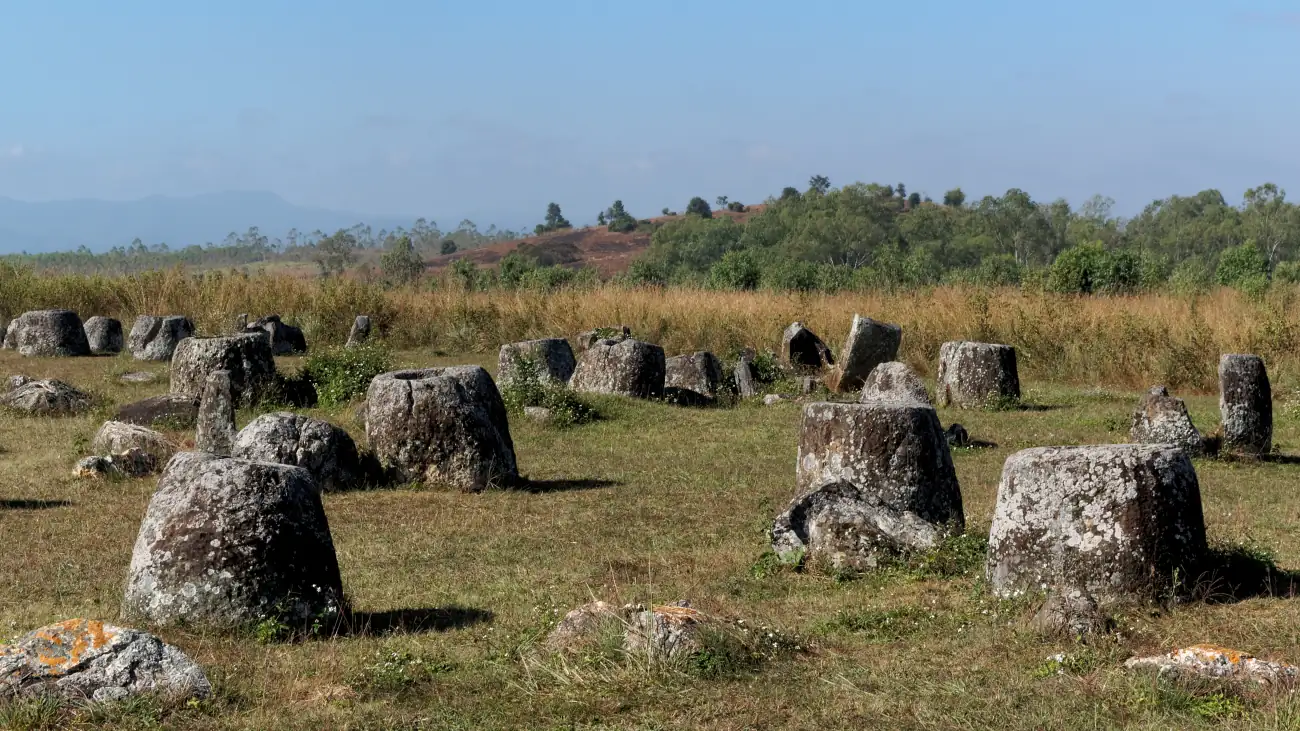
Large stone vessels stand in groups across the Xieng Khouang plateau of central Laos. Some are waist high; others are taller than a person. They occupy ridges, slopes and open ground, often with wide views across routes through the highlands. More than 2,100 jars have been recorded, distributed among dozens of separate locations.
The name Plain of Jars suggests one field filled with identical objects. The archaeological landscape is much broader. Jars vary in stone, shape, size and workmanship. Quarries, unfinished vessels, stone discs, grave markers, buried human remains and artefacts connect them to a long and changing treatment of the dead.
Carving and moving the jars
Most jars were made from sandstone, although granite, conglomerate, limestone and breccia were also used. Craftspeople selected large blocks and hollowed them with iron tools. Tool marks and unfinished examples near quarries preserve stages of production that completed jars no longer show.
Moving a vessel weighing several tonnes across steep ground required planning and labour. No surviving text explains the method. Sledges, rollers, timber frameworks, ropes and seasonal ground conditions have all been considered, but experiments have not produced one universal answer. Different sites may have used different routes and techniques.
The locations were deliberate. Many jar groups sit near paths through the plateau and between river systems. UNESCO describes the region as a crossroads between the Mun-Mekong and Red River cultural spheres. Movement through the highlands may have supported exchange, pilgrimage, political relationships or funerary gatherings.
What were the jars for?
Early explanations ranged from water storage to containers for fermenting rice wine. Local stories also connected the vessels with a legendary king and a race of giants. Such traditions belong to the cultural history of the landscape, but archaeology points strongly toward mortuary use.
Excavations around jars have found primary burials, bundles of selected bones, ceramic burial vessels, teeth, beads, iron objects and other offerings. Stone discs once called lids often occur beside burials rather than on top of jars, and some carry human or animal carvings on the buried face.
The exact role of the large stone vessels probably changed. They may have held bodies during one stage of decomposition, received selected remains later, marked gathering places or served as durable monuments around which other burials accumulated. A single explanation for every jar and site is unlikely.
Recent excavation at Site 75 documented human remains placed inside one large stone jar. The bones represented multiple people and were deposited at different times, suggesting repeated secondary burial and acts of remembrance. That discovery confirms one direct mortuary use, but it does not prove that all jars functioned identically.
A longer chronology than one label suggests
UNESCO broadly dates the main mortuary landscape from about 500 BCE to 500 CE. Scientific dating has made the sequence more complicated. Optically stimulated luminescence measurements suggest that some jars may have been positioned as early as the late second millennium BCE. Radiocarbon dates from human remains at several sites can be many centuries later.
This gap need not mean the measurements contradict one another. Stone monuments can attract ceremonies, burials and stories long after their makers are gone. Some jar fields may have remained meaningful places for generations, with later communities adding graves or returning to ancestral ground.
Dates also differ from site to site. Only a small portion of the full landscape has been excavated, and tropical soils do not always preserve bone or organic material well. The chronology will continue to change as more samples are recovered from secure contexts.
War inside an archaeological landscape
Xieng Khouang was heavily bombed during the conflicts of the 1960s and 1970s. Bomb craters cut through jar fields, vessels were broken and unexploded ordnance remained in the ground. The danger restricted farming, travel, excavation and conservation for decades.
The components inscribed on the World Heritage List were cleared of unexploded ordnance before inscription. That achievement does not mean every unsurveyed area around the plateau is safe. Archaeological work and local access still depend on careful clearance and marked routes.
War damage is now part of the physical history of the sites. Conservation cannot restore the plateau to an imagined untouched state. It has to protect ancient features, record modern destruction and support communities living among both.
Many sites, one protected property
The World Heritage property includes fifteen components containing 1,325 jars along with quarries, discs, burials and manufacturing evidence. Nearby villages help manage several locations and share income from visitors. Their involvement reflects the fact that the jar fields are spread through an inhabited landscape rather than enclosed within one archaeological park.
Erosion, vegetation, cattle, roads and tourism continue to affect the sites. Stone seems permanent, yet water can split weakened surfaces and movement around jars can damage buried deposits that have never been excavated.
The Plain of Jars remains mysterious in the honest archaeological sense: evidence exists, but many relationships are unresolved. The jars were built with formidable skill, connected with mortuary practice and revisited across a long span of time. That grounded story is richer than a puzzle requiring one sensational solution.