
Prambanan
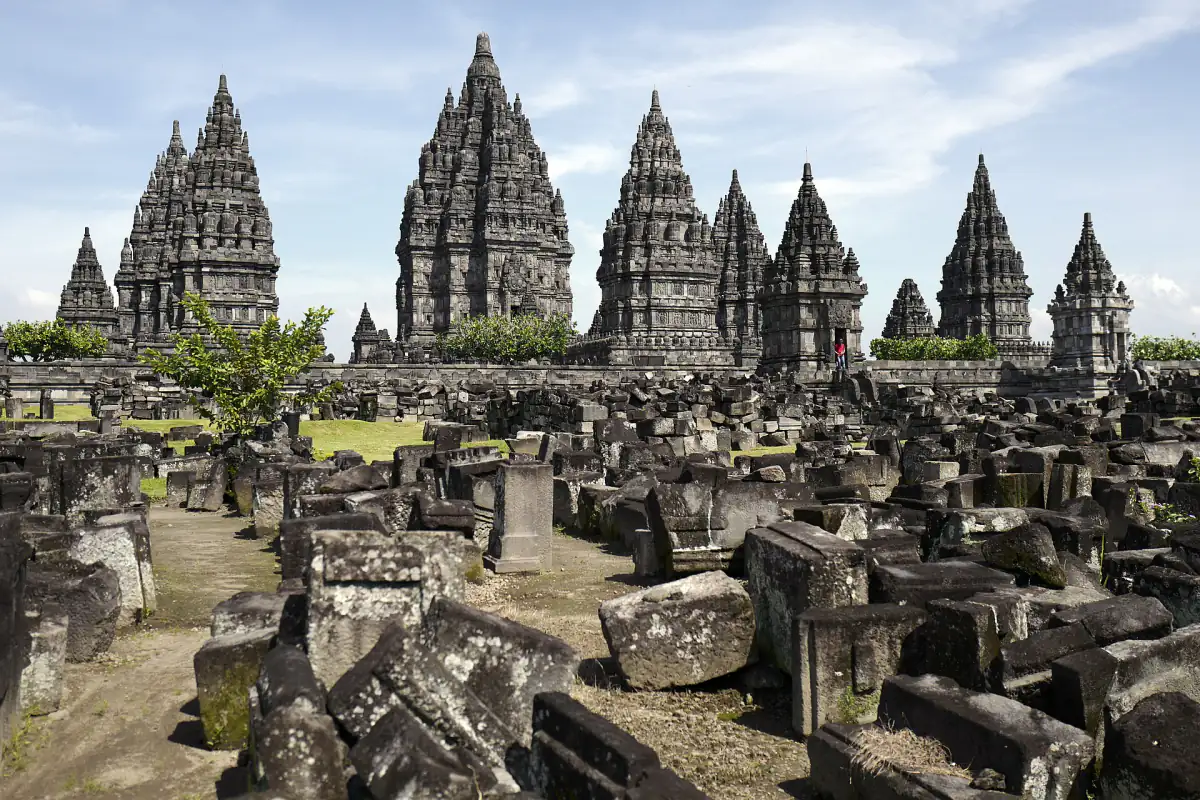
Trio of Hindu spires dedicated to Shiva, Vishnu, and Brahma. Toppled by an earthquake in the 16th century, partially restored.
The central tower of Prambanan rises 47 metres above the plains of central Java. Its steep outline is surrounded by smaller towers, guardian figures, narrative reliefs, and the remains of hundreds of shrines. Built in the ninth century, the complex was dedicated above all to Shiva, while temples for Brahma and Vishnu completed a monumental expression of the Hindu Trimurti.
Prambanan stands within a landscape where Hindu and Buddhist monuments were built close together. The Buddhist complexes of Sewu, Lumbung, and Bubrah form part of the same UNESCO World Heritage property. Their proximity does not prove that every political or religious relationship was peaceful, but it does show that central Javanese courts supported several sacred traditions within the same region.
The House of Shiva
An inscription dated 856 CE describes a sanctuary called Shivagrha, the House of Shiva, and is widely connected with Prambanan. Construction probably began under Rakai Pikatan and continued under his successors in the Mataram kingdom. The inscription also records a water project that altered the course of a river near the sacred compound.
The main courtyard places three large temples in a north-south line. Shiva's temple occupies the centre and is the tallest. Brahma's stands to the south and Vishnu's to the north. Facing them are smaller temples associated with each deity's animal mount: Nandi the bull for Shiva, Hamsa the swan or goose for Brahma, and Garuda for Vishnu.
The central Shiva temple contains several chambers. The principal image presents Shiva Mahadeva. Other chambers hold Ganesha, the elephant-headed son of Shiva; Agastya, a revered sage; and Durga. The Durga image later became identified in local tradition with Roro Jonggrang, the "slender maiden" of Prambanan's best-known legend.
Stories carved around the temples
Visitors moving along the temple galleries encounter reliefs from the Ramayana. The story unfolds across the balustrades of the Shiva and Brahma temples, requiring movement around the buildings to follow it. Reliefs on the Vishnu temple draw from stories of Krishna.
These carvings do more than illustrate a text. Clothing, buildings, plants, animals, musical instruments, and boats were rendered through Javanese artistic conventions. An Indian epic was retold within a local court culture. The result belongs to Java rather than being a stone copy of a distant model.
The towers also use repeated architectural forms to evoke the sacred mountain Meru. Successive levels draw the eye upward toward dense clusters of smaller spires. From the ground, the building appears to multiply as it rises. The effect joins cosmology to engineering, since the weight of this stone architecture had to be carried in a region vulnerable to earthquakes.
Hundreds of temples, two different counts
The central Loro Jonggrang compound originally contained about 240 temples. Most were small perimeter shrines arranged in four rows around the principal courtyard. Many now survive only as sorted blocks and foundations.
UNESCO gives a larger total of 508 stone temples for the full World Heritage property. That figure includes Prambanan together with Sewu and the other neighbouring compounds. The numbers are sometimes presented as if they describe the same enclosure, which creates avoidable confusion.
Sewu is Buddhist and slightly older than the main Prambanan sanctuary. Its presence complicates an easy tale of one religion replacing another. Royal families, patrons, and communities could support different institutions, and political identities did not always map neatly onto a single faith.
The legend of Roro Jonggrang
According to a popular Javanese story, Prince Bandung Bondowoso was ordered to build one thousand temples in a single night before he could marry Princess Roro Jonggrang. The princess tricked him by having fires lit and rice pounded before dawn, making the supernatural builders believe morning had arrived. When the prince discovered the deception, he turned her to stone as the final statue.
The legend is not a construction record. It developed as local people explained impressive ruins whose builders and inscriptions were no longer remembered. It remains culturally important because it shows how the temples continued to live in storytelling long after royal patronage ended. The site was never simply "discovered" by Europeans. Nearby communities already knew the stones and named them.
Collapse and reconstruction
The political centre of the kingdom shifted eastward during the tenth century. Earthquakes, volcanic activity, vegetation, stone removal, and the end of sustained royal maintenance contributed to the compound's deterioration. Towers collapsed into vast piles of interlocking blocks.
Systematic restoration began in 1918. Rebuilding a temple requires enough original stones to establish its form, while modern supports must not pretend to be ancient fabric. The main Shiva temple was reconstructed and inaugurated in 1953. Work on other structures has continued, and the earthquake of 2006 demonstrated how vulnerable restored monuments remain.
Prambanan is also a place of present religious practice. Hindu ceremonies have returned to the complex, while performances of the Ramayana draw on the stories carved into its walls. The site survives through a combination of archaeology, worship, conservation, tourism, and legend. No one of those uses fully explains it, but together they show why the towers remain part of Java's living cultural landscape.