
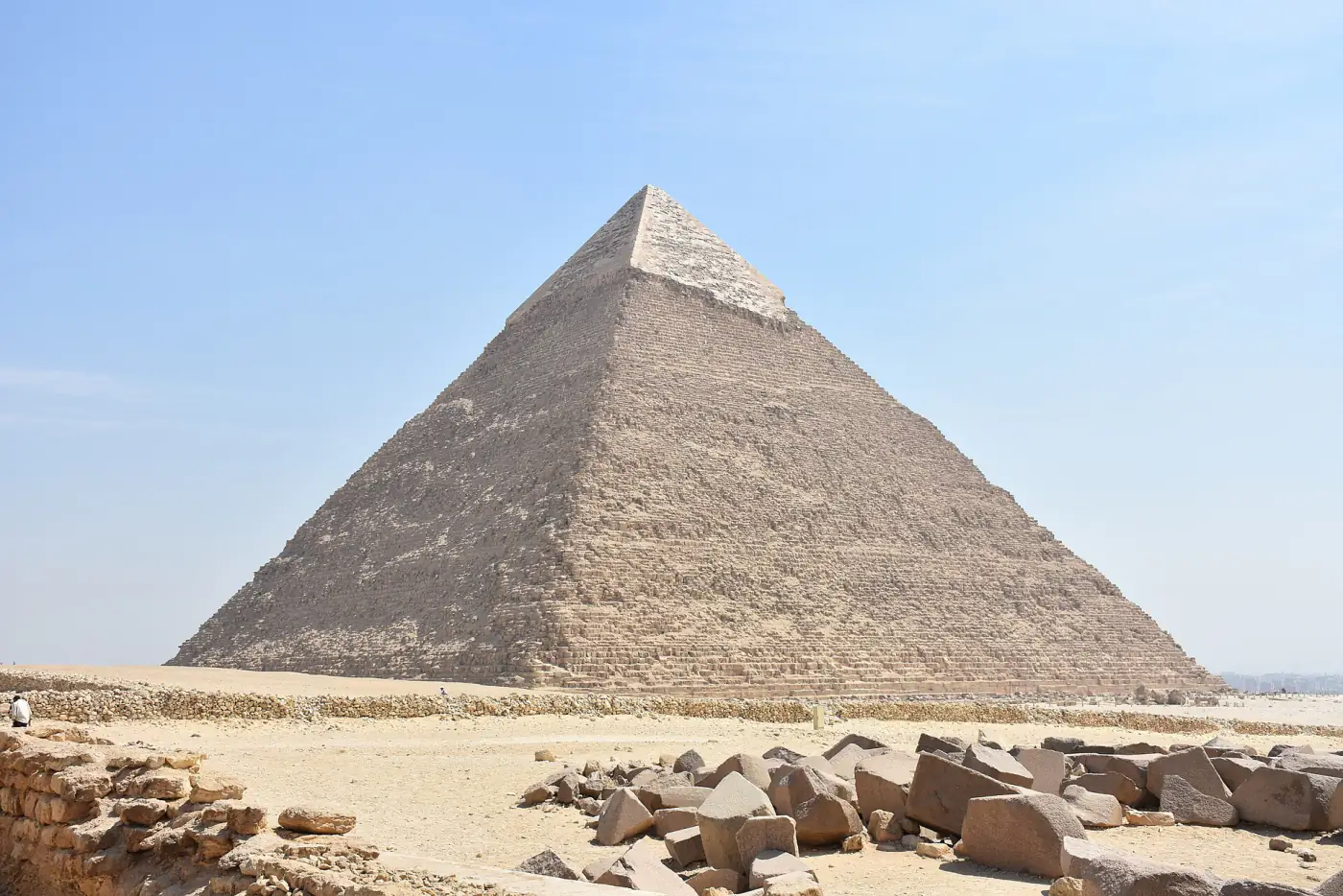
Pyramid of Khafre
Second-largest pyramid at Giza, still bearing remnants of its original limestone casing near the apex. Its funerary complex is closely associated with the Great Sphinx.
The pyramid in the middle of the Giza skyline often looks like the largest. A cap of pale casing stone still clings to its summit, and its base stands on higher ground than the Great Pyramid beside it. The impression is convincing. The measurements tell a different story: Khafre’s pyramid originally rose about 143.5 metres, a few metres short of the monument built for Khufu.
That visual trick has probably caused millions of visitors to misidentify it. It also hints at the care with which the Giza plateau was planned. The Pyramid of Khafre was one part of a long architectural sequence running from the desert edge to the royal tomb. Temples, a processional causeway, statues and the Great Sphinx turned the surrounding landscape into a place where kingship could be performed after the king had died.
Archaeologists attribute the complex to Khafre, a Fourth Dynasty ruler and son of Khufu. Egyptian chronologies differ by several decades, but his reign is generally placed in the middle of the twenty-sixth century BCE. No royal body has survived to provide a direct identification. The strongest evidence comes from the complex itself: statues naming and portraying Khafre were found in the valley temple, while the connected buildings form a coherent royal programme.
A white pyramid above the plateau
The core was built mainly from local limestone. Its exterior was once covered with finer white limestone brought from Tura on the eastern side of the Nile. Most of that casing disappeared in later periods, when ancient monuments became convenient sources of cut stone. The surviving band near the top gives a rare glimpse of the smooth, bright surface the whole pyramid once presented.
Khafre’s builders used the natural plateau to strengthen the effect. The monument occupies a higher part of the site than Khufu’s pyramid, and its sides rise at a slightly steeper angle. From Cairo and from many points on the plateau, the two giants therefore appear close in height.
The scale should not hide the practical work behind it. Stone had to be quarried, shaped, hauled and set in regular courses. Food, water, tools, timber and replacement labour had to reach the plateau continuously. The pyramid records both royal ambition and an organised society able to keep that work moving over years.
The interior is far less elaborate than the mass above suggests. Two entrances connect with a passage system ending in a burial chamber cut partly into the bedrock. A stone sarcophagus remains, but the burial and its equipment were gone when the chamber entered the modern archaeological record. The emptiness cannot tell us exactly when the tomb was robbed or what the original funeral contained.
A monument that began at the valley
Visitors approaching in antiquity would have encountered the complex from the east. A valley temple stood near the edge of the cultivated land. A long causeway climbed from it to the mortuary temple at the foot of the pyramid. These buildings were settings for the royal funeral and for the offering cult that followed it. Priests maintained the dead king’s memory, presented food and drink, and addressed images through which his presence could continue.
Khafre’s valley temple is one of the best-preserved Old Kingdom temples. Massive limestone core blocks were faced with granite, while alabaster covered parts of the floor. Monolithic granite pillars formed a severe, ordered hall. Niches held multiple statues of the king in hard stones brought from distant quarries.
One of those statues now provides the best-known image of Khafre. The king sits upright on his throne while the falcon god Horus spreads protective wings behind his head. It is an ideal royal body rather than an informal portrait. The calm face, strong limbs and union of king with deity presented the kind of ruler the monument was meant to preserve forever.
The temples matter because a pyramid was not designed as an isolated container for a corpse. Harvard’s Digital Giza project describes these complexes as working ceremonial systems. A royal funeral moved through them once. Offerings, recitations and maintenance then continued for generations, supported by people and estates whose labour rarely appears in popular images of Giza.
How the Sphinx fits the evidence
The Great Sphinx stands beside the eastern end of Khafre’s causeway, close to his valley temple. This relationship has made Khafre the leading candidate for the ruler under whom the Sphinx took its present form. The attribution is strong, but it is better treated as an archaeological conclusion than as an inscription carved on the statue.
Research by Ancient Egypt Research Associates links the Sphinx quarry to blocks used in the Sphinx Temple and Khafre’s valley temple. Architectural joins and unfinished surfaces also help establish a sequence: the valley temple came first, followed by the Sphinx and its temple late in Khafre’s building programme. The Sphinx Temple itself appears never to have been completed.
These connections place the Sphinx firmly within the Old Kingdom landscape at Giza. They do not answer every question. Khufu may have begun work in the area, and scholars continue to debate details of the sequence. Claims that the Sphinx predates the pyramids by many thousands of years have not produced comparable archaeological evidence.
What survives beyond the illusion
Khafre’s pyramid remains powerful partly because it has kept more of its outer silhouette than most Egyptian pyramids. Yet its meaning becomes clearer lower down, among temples, quarries, roads, tombs and settlement remains. Those traces restore the human activity that a perfect triangular profile can erase.
The monument also resists a simple certainty. Khafre is securely associated with the complex, but his body is missing. The Sphinx fits his programme, but no surviving inscription on the statue names him. The casing shows how the pyramid looked, while also recording centuries of removal and reuse.
Giza is compelling because evidence survives at several scales at once. A polished stone at the summit belongs to the same history as a statue fragment in a museum, a quarry bed beside the Sphinx and a temple floor worn by movement. Together they reveal a royal project more extensive, and more interesting, than the pyramid alone.
Sources
- Egyptian Ministry of Tourism and Antiquities: Pyramid Complex of Khafre
- Digital Giza, Harvard University: Royal Pyramid Complexes
- Ancient Egypt Research Associates: Khafre’s Monuments as a Unit
- The Metropolitan Museum of Art: Fragmentary Face of King Khafre
- UNESCO World Heritage Centre: Memphis and its Necropolis