San Agustín
Largest cluster of pre-Columbian megalithic statuary in South America. Hundreds of stone figures guarding burial mounds in the upper Magdalena valley.
Hundreds of stone figures watch over burial mounds, terraces and forest paths in the upper Magdalena region of southern Colombia. Some appear human. Others combine fangs, claws, beaks, snakes and carefully held objects. Their expressions can seem fierce, amused or completely unreadable depending on the light and the viewer.
The sculptures are usually grouped under the name San Agustín culture, but no ancient text records what their makers called themselves. Archaeology points to communities that occupied the region across many centuries, changing their settlements, pottery, burial customs and political relationships. A single label helps organise the evidence; it should not turn a long history into one static people.
A landscape of communities and tombs
The upper Magdalena lies among mountains, valleys and volcanic soils near the headwaters of Colombia's largest river. Paths through the region connected the Andes with areas toward the Amazonian lowlands, the Pacific and the north. Obsidian, gold and other materials show that communities participated in wider networks.
People farmed maize and other crops, lived in scattered households and built ceremonial centres. Archaeological survey suggests that population and social organisation changed gradually from at least the first millennium BCE. Monumental funerary construction became especially prominent during the Regional Classic period, roughly the first through ninth centuries CE.
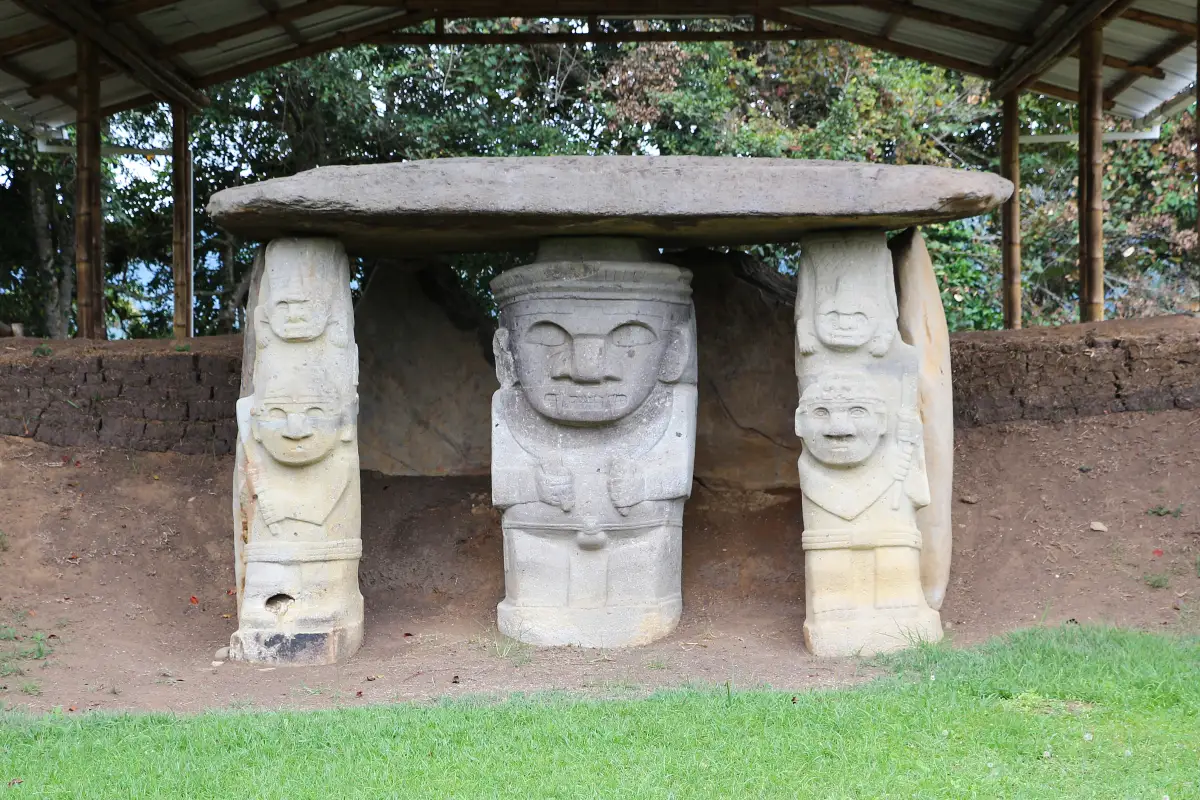
Leaders and other important people were buried inside stone-lined tombs covered by earthen mounds. Large slabs formed corridors and chambers. Statues stood as guardians, witnesses or participants in ceremonies whose exact words are lost. Residential remains near some monuments show that these were not isolated cemeteries far from daily life.
The distribution of mounds suggests several centres rather than one capital ruling a unified state. Communities could share artistic and ritual traditions while maintaining separate leaders and territories. Monument building expressed status, but it also required cooperation from households that gathered, moved stone, prepared food and took part in ceremonies.
Figures that resist simple translation
San Agustín's sculptors worked mainly in volcanic stone. They created freestanding statues, reliefs, sarcophagi, columns and slabs. Some figures wear headdresses or necklaces. Some carry clubs, tools, small beings or animals. Human faces may be paired with jaguar-like teeth, bird features or snakes.
These combinations are often interpreted as deities, ancestors, ritual specialists or transformations between human and animal states. Such ideas are plausible because the sculptures stood in funerary and ceremonial settings, but no one-to-one dictionary survives. A jaguar feature does not always mean a jaguar god, and a frightening face does not necessarily represent evil.
Traces of red, yellow, black and white pigment show that some statues were painted. Weathered grey stone is therefore an incomplete modern appearance. Colour would have separated clothing, skin, ornaments and supernatural features, making the figures more visually immediate during ceremonies.
The best context for interpretation comes from the monuments themselves: where a figure stood, which tomb it faced, what offerings lay nearby and how people approached the mound. Looting and early removal destroyed much of that information. A sculpture preserved in a museum may survive physically while losing part of its archaeological meaning.
Water carved into ceremony
At Fuente de Lavapatas, channels, basins and figures were cut directly into the rocky bed of a stream. Water flows around human and animal forms before continuing downhill. The place is frequently described as a sacred fountain or ritual bathing site.
Those labels are reasonable but broad. The carving shows that water was deliberately guided through an image-filled surface. Whether people used it for purification, offerings, initiation, healing or several practices at different times remains uncertain. The monument makes the landscape itself part of the architecture.
Other groups include Las Mesitas, Alto de los Ídolos and Alto de las Piedras. The World Heritage property protects several separate areas rather than every known sculpture in the region. UNESCO estimates that roughly a third of about six hundred recorded statues and half of approximately forty monumental mounds lie within the inscribed park boundaries.
Discovery, looting and protection
European written descriptions of the statues appeared by the seventeenth century, although local people already knew the monuments. Nineteenth and early twentieth-century visitors documented, excavated and removed sculptures. Some research created valuable records; treasure hunting and collecting also separated objects from their original settings.
Colombia created the archaeological park in 1931, making San Agustín central to the country's developing system of heritage protection. The park is now managed by the Colombian Institute of Anthropology and History, ICANH. San Agustín, Alto de los Ídolos and Alto de las Piedras were inscribed on the World Heritage List in 1995.
Conservation in an open, wet landscape is continuous. Rain, plant growth, soil movement, visitor contact and earlier repairs affect the stone. Moving every sculpture indoors would protect surfaces but sever the relationship between figure, tomb and terrain. Keeping them outside preserves context while demanding monitoring and careful intervention.
Some statues in the Bosque de las Estatuas were moved long ago and cannot be returned confidently to their original positions. The modern display acknowledges that loss while allowing visitors to see the range of forms. It is a reminder that a park is also a history of archaeological decisions.
More than a gallery of strange faces
San Agustín is sometimes presented as an inexplicable civilisation that vanished. The evidence offers a grounded alternative. Farming communities lived across the upper Magdalena for many generations. They created political distinctions, honoured particular dead, reshaped hills with mounds and developed a stone-carving tradition capable of holding human, animal and other-than-human qualities in one body.
Later populations changed and monuments fell out of active use, but the region did not become an empty stage waiting for archaeologists. It remained a lived Colombian landscape. The statues are compelling because they preserve a visual language we can study without pretending to translate every sign.