Seokguram Grotto
Purpose-built granite grotto containing a monumental seated Buddha and sculpted attendants, arranged as a carefully designed Buddhist cave sanctuary.
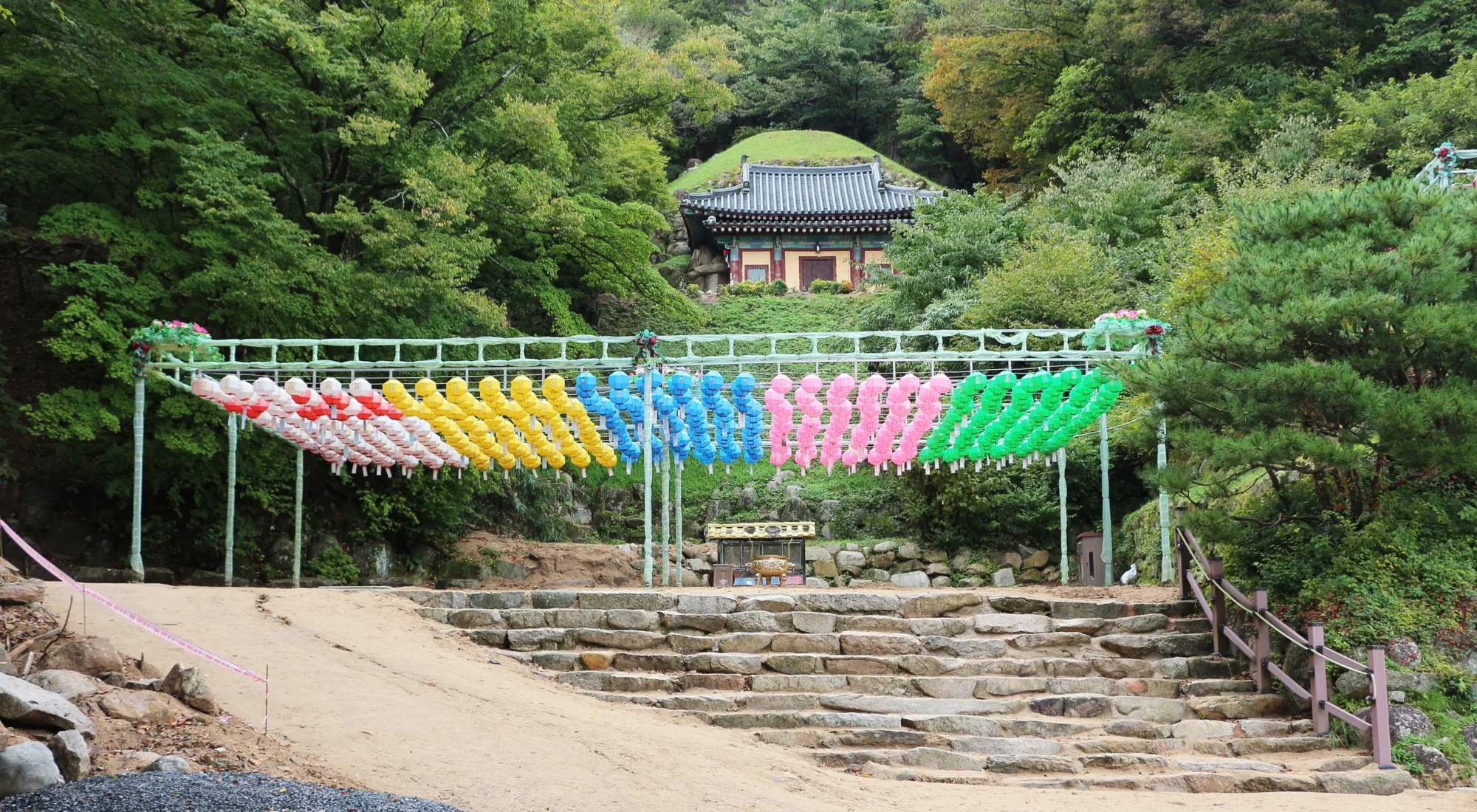
Seokguram is called a grotto, but no sculptor simply entered a natural cave and began carving. The sanctuary was engineered from blocks of granite, assembled into chambers and then covered by earth on the slope of Mount Toham. Its builders made a cave where the mountain had not provided one.
Inside, a monumental Buddha sits at the centre of a circular chamber. Guardians, disciples, bodhisattvas and deities surround him in stone. The arrangement can feel effortless, as though the figures have always belonged to the darkness. In reality, the sanctuary is the result of exacting design, followed by more than a century of difficult attempts to keep water, air and modern visitors from damaging it.
A sanctuary of Unified Silla
Seokguram was created in the eighth century, when Gyeongju was the capital of the Unified Silla kingdom. It forms a single religious complex with Bulguksa Temple farther down the mountain. UNESCO dates the complex to the period of Prime Minister Kim Dae-seong, who is traditionally said to have begun the work in 751.
The thirteenth-century Korean collection Samguk Yusa connects Kim Dae-seong's two foundations to filial devotion. Bulguksa was dedicated to his parents in his present life, the story says, while Seokguram honoured parents from a former life. The account was written centuries after the construction and should not be read as a contemporary building record. It does show how later Korean tradition understood the two monuments as related acts of Buddhist piety.
The complex was completed during a period when Silla rulers and elites supported Buddhist temples, images and scholarship on an ambitious scale. Seokguram turned that patronage into a carefully ordered sacred interior.
An artificial cave in granite
Visitors approach through a rectangular antechamber and a narrow corridor before entering the rotunda. More than 360 stone slabs were used in the structure, according to UNESCO. Granite is durable, but it is also difficult to carve and unforgiving to assemble. The builders had to create a stable dome and manage the pressure of the earth around it without modern mortar or a single continuous rock face.
The circular chamber is organised around the seated Sakyamuni Buddha. His right hand reaches toward the ground in the earth-touching gesture, recalling the moment of enlightenment when the Buddha called the earth to witness. His left hand rests in meditation.
Reliefs on the surrounding walls place the central image within a wider Buddhist world. Devas, bodhisattvas, disciples, guardians and Vajrapani figures occupy an ordered sequence rather than a random crowd. The movement from the outer chamber through the corridor to the rotunda also changes the visitor's experience: from a more compressed, guarded approach into a balanced space focused on the Buddha.
What the Buddha faces
The sanctuary opens toward the east, and the Buddha is commonly described as looking toward the sea. That orientation has encouraged poetic claims about sunrise alignments and distant sacred points on the coast. The eastern outlook is real; the more elaborate astronomical stories are harder to demonstrate.
Seokguram does not need a hidden code to explain its power. Direction, controlled approach, the contrast between rectangular and circular spaces, and the hierarchy of images already create a strong religious programme. The sanctuary translates Buddhist ideas into movement, proportion and stone.
Restoration solved one problem and created another
By the early twentieth century, parts of the grotto had collapsed or were buried, and water was entering the structure. During Japanese colonial rule, the sanctuary was dismantled and rebuilt between 1913 and 1915. Concrete was placed around the stone chamber in an attempt to stabilise and waterproof it.
The intervention changed how the building breathed. Moisture became trapped, condensation formed and biological growth affected the stone. Later repairs added drainage, waterproofing and, in the 1960s, a second concrete dome with an air space between the two shells. Ventilation and climate control were introduced, while a glass wall separated the interior from visitors.
The National Research Institute of Cultural Heritage has documented this long history of repair and monitoring. It is a useful warning against simple restoration stories. An intervention can prevent collapse and still create new risks that only become clear years later.
UNESCO notes that the twentieth-century reconstruction diminished aspects of the grotto's formal authenticity, even though the main statue and most sculptures retain their original form. Temperature, humidity, mould, water ingress and the effects of mechanical systems remain subjects of careful management.
A masterpiece that cannot be treated as a picture
Seokguram and Bulguksa were added to the UNESCO World Heritage List in 1995. The grotto is also protected as a Korean National Treasure. Access to the chamber is controlled, and the glass barrier can frustrate anyone hoping for an unobstructed photograph. Its purpose is not theatrical distance. Human bodies alter temperature and humidity, and the sanctuary has already endured the consequences of environmental instability.
The central Buddha is the image people remember, but Seokguram is more than a sculpture display. It is architecture, engineering, landscape and ritual sequence working together. The artificial cave is itself part of the achievement: a mountain sanctuary assembled stone by stone, made to feel as if it had been discovered rather than built.
Sources
- UNESCO World Heritage Centre: Seokguram Grotto and Bulguksa Temple
- Korea Heritage Service: Seokguram Grotto, Gyeongju
- National Research Institute of Cultural Heritage: conservation monitoring at Seokguram
- Korea Tourism Organization: Seokguram Grotto and Bulguksa Temple
- UNESCO World Heritage Committee: 1995 inscription decision