
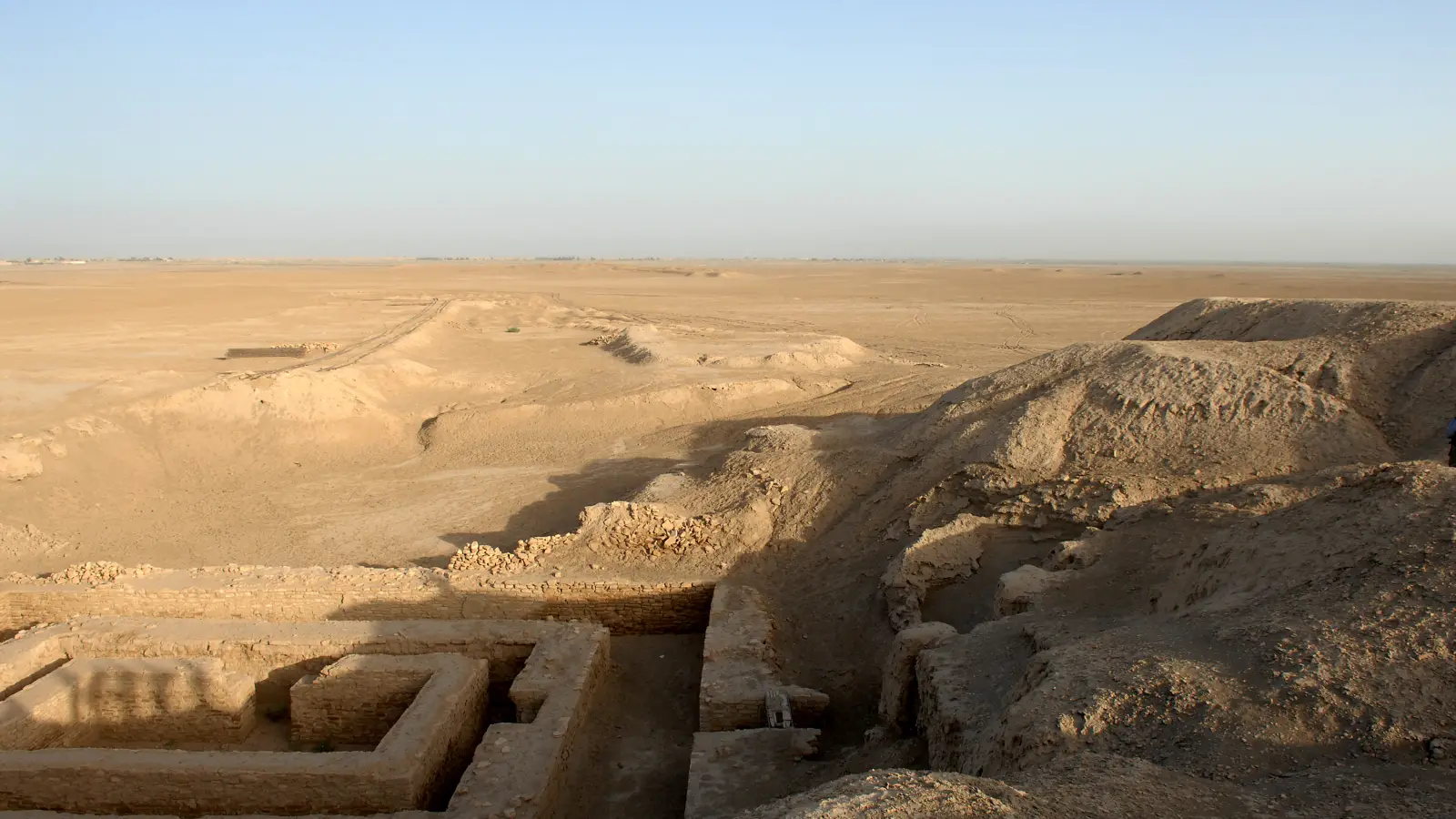
Uruk
One of the world's earliest large cities. Late fourth-millennium administrative tablets from Uruk preserve proto-cuneiform, among the earliest writing known.
Uruk grew in southern Mesopotamia, in the alluvial plain between the Tigris and Euphrates. By the late fourth millennium BCE it had become an enormous settlement with monumental buildings, specialised workers, temples, workshops, and a system of administration that depended on recording goods in clay.
The city is closely associated with the beginnings of urban life and writing. Those achievements did not appear in a single moment, and Uruk was not the only settlement involved. Its importance comes from the concentration of evidence showing how large communities, institutions, and record-keeping developed together.
From settlement to city
Uruk had been occupied before the period that bears its name, but the city expanded dramatically during the fourth millennium BCE. Two major sacred areas, the Eanna precinct and the district later associated with the god Anu, became centres of monumental construction.
The buildings were made mainly from mud brick. Their walls were decorated with coloured clay cones pressed into the surface, producing patterns that caught the light. Some structures were rebuilt repeatedly, leaving deep architectural layers beneath the later city.
The size of the settlement required more than a royal household. Farmers supplied grain and animals, craftspeople made pottery, tools, textiles, and ornaments, and workers moved materials through the city. The institutions that organised this activity were connected to temples, but the exact balance between temple authority, household power, and political leadership changed over time.
Clay tablets and the work of counting
The earliest tablets from Uruk are mostly administrative. They record quantities of grain, animals, workers, and rations. The signs began as pictorial marks but developed into a more flexible system as scribes found new ways to express names, actions, and abstract information.
These early records were not written to preserve a story for later readers. They were practical tools for managing an economy. That makes them especially useful. A tablet listing barley or labour is evidence of a real institution trying to keep track of resources, even if the people who handled the goods remain anonymous.
Over time, writing became capable of recording royal inscriptions, legal decisions, religious texts, and literature. Uruk's later association with Gilgamesh belongs partly to this literary tradition. The epic poems were written down in later periods, so they should not be treated as a direct biography of a king who lived during the city's first great expansion.
Temples and monumental space
The Eanna precinct contained large halls, courtyards, platforms, and decorated facades. Its buildings were rebuilt so often that the sacred area became a layered record of changing plans. The scale of the work suggests institutions able to gather and direct labour across the settlement.
The monuments served religious purposes and practical ones. Temples held land, animals, tools, stored goods, and staff. Their accounts could therefore connect ritual with farming, craft production, transport, and distribution. A city could grow around such institutions because they were places of belief and places where practical decisions were made.
Uruk's walls are famous from later tradition, but the city's defensive history is difficult to reduce to one construction episode. Walls could mark a boundary, control movement, or protect the settlement, while their date and extent changed over time. The archaeological city was not a single plan drawn at the beginning and left intact.
Networks beyond the plain
Southern Mesopotamia lacked many raw materials needed for large-scale construction and craft. Stone, timber, metals, and luxury materials travelled from other regions. Uruk was connected to a wide exchange network, and its influence can be seen in settlements that adopted related forms of pottery, administration, and monumental architecture.
The spread of Uruk-style objects does not necessarily mean that Uruk ruled a territorial empire. Some communities may have copied institutions or styles because they were useful in their own settings. Others may have hosted merchants or administrators from southern Mesopotamia. The evidence supports strong connections, but the exact political arrangements remain debated.
The long life of Uruk
Uruk continued through the Early Dynastic, Akkadian, Babylonian, and later periods. Its importance changed as political centres shifted, but the city did not disappear when its first urban expansion ended. Temples were rebuilt, rulers claimed associations with its ancient prestige, and the settlement remained part of the history of Mesopotamia for millennia.
Modern excavation began in the early twentieth century and continues to shape what visitors know about the site. Large areas remain difficult to investigate, and exposed mud-brick architecture needs protection from water, salt, wind, and neglect.
Ur shows a later Sumerian city where royal building and written administration are especially visible. Babylon inherited and transformed Mesopotamian urban traditions.
Before the library and the epic
Uruk's place in history is sometimes explained through a single claim: it was the first city or the birthplace of writing. Both phrases point toward real evidence, but neither should hide the gradual process behind them. Villages became larger settlements, institutions found ways to organise work, and marks on clay became a writing system over generations.
Uruk lets us watch that process at an unusually large scale. The city is made of monumental precincts and ordinary labour, of religious institutions and accounting tablets, of local mud brick and materials brought from far away. Its most important invention may not have been writing alone, but the administrative world that gave people a reason to write.