Valley of the Kings
New Kingdom royal cemetery cut into the cliffs west of Luxor. More than sixty numbered tombs are known, including KV62, Tutankhamun's largely unplundered burial.
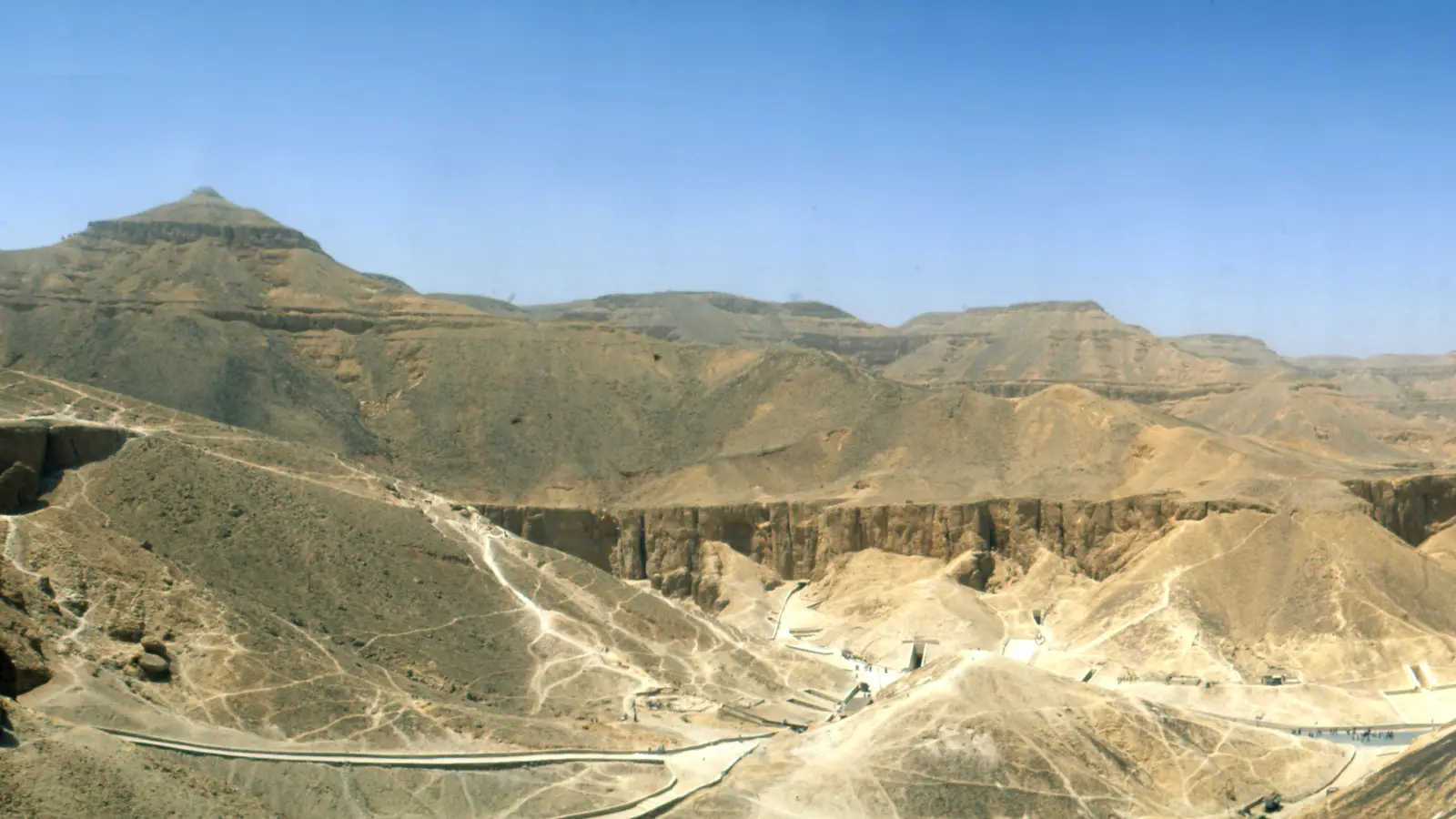
The Valley of the Kings is often reduced to one discovery: Tutankhamun's tomb, opened in 1922 with much of its burial equipment still inside. Yet the dry wadis west of Luxor contain a much larger royal cemetery. More than sixty tombs, along with unfinished shafts and chambers, were cut here for rulers, members of the royal family, and a small number of highly placed people during Egypt's New Kingdom.
This was not a city of the dead in the ordinary sense. It was a protected landscape linked to the temples, palaces, workshops, and estates of Thebes. Every royal burial required surveyors, quarrymen, scribes, painters, carpenters, priests, guards, and administrators. The hidden entrances may be the valley's most visible features today, but the work behind them reached far beyond the cliffs.
Why bury kings in a desert valley?
New Kingdom rulers moved away from the great above-ground pyramids used by many earlier kings. Their tombs were excavated into the rock of an isolated valley on the Nile's west bank, the side associated with sunset, death, and renewal. Above the valley rises al-Qurn, a mountain peak whose outline can appear pyramid-like from certain directions.
The setting offered symbolism and seclusion, although neither guaranteed safety. Tomb robbery was already familiar to the Egyptians, and many burials in the valley were entered and stripped in antiquity. Officials later moved some royal mummies and burial goods into caches in an effort to protect what remained. A concealed tomb could slow a robber; it could not erase the knowledge of the people who had built, provisioned, sealed, and guarded it.
The first New Kingdom king securely known to have been buried here was Thutmose I of the Eighteenth Dynasty. The main period of royal use continued through the Nineteenth and Twentieth Dynasties, ending around the close of the New Kingdom in the late second millennium BCE.
A tomb was made during a reign
The royal tombs were not cut according to one unchanging plan. Their corridors, shafts, pillared halls, side chambers, and burial rooms developed across centuries. Some routes bend; later examples tend to follow straighter axes. A long reign allowed a tomb to grow deeper and receive a more extensive programme of decoration. A king who died early could leave builders with an urgent problem: prepare a workable burial before the ideal design was complete.
Much of this labour was carried out by a specialist community based at Deir el-Medina. The workers called themselves servants in the Place of Truth. Crews of quarrymen, draftsmen, sculptors, painters, scribes, and carpenters walked from their walled village toward the royal cemeteries. Their houses, tombs, tools, notes, and administrative records preserve an unusually close view of the people behind royal monuments.
The walls were more than decoration. Images and texts guided the dead king through the night world, placed him among the gods, and anticipated his rebirth with the sun. Different tombs preserve selections from funerary compositions now known by modern titles such as the Amduat, the Book of Gates, and the Book of Caverns. Their painted figures turn corridors into a mapped sacred journey.
Tutankhamun was the exception, not the model
Tutankhamun's burial became famous because it was found relatively intact, not because his tomb was the grandest in the valley. KV62 is small compared with the long, elaborately decorated tombs of rulers such as Seti I and Ramesses VI. Its rooms were crowded with thousands of objects, many stacked tightly because the young king's death left little time to prepare a larger resting place.
That survival changed the way the modern world imagines an Egyptian royal burial. Gold, furniture, chariots, clothing, food containers, weapons, games, and ritual objects made it possible to see the tomb as an equipped place rather than an empty sequence of rooms. Most other royal tombs had lost much of this material long before modern excavation.
The numbering system can also be misleading. Labels such as KV62 are modern archaeological tools, not ancient names. They help researchers map a crowded landscape in which a small shaft, an unfinished cutting, and a many-roomed royal tomb may stand close together.
The valley is still an archaeological site
The Valley of the Kings is not finished simply because its most famous entrances are known. Plans, inscriptions, fragments, human remains, and traces of work continue to change how individual tombs are understood. The Theban Mapping Project has documented the valley's topography and tomb plans, making it possible to compare spaces that visitors could never grasp from a single walk underground.
Conservation is as important as discovery. Flash floods can drive water and debris into low entrances. Salt, dust, changing humidity, crowds, and physical contact place pressure on painted surfaces that survived for more than three thousand years in a dry and relatively stable environment. Opening a tomb to visitors makes its history visible, but it also changes the conditions that preserved it.
The valley's real scale becomes clear only when it is reconnected to Thebes. Across the west bank stood mortuary temples where royal cults were maintained. On the east bank, Karnak and Luxor Temple belonged to the religious life of the same capital. The tombs were hidden, but the kings buried within them were remembered through a much larger ceremonial landscape.